JRC Web is an SEO agency in Martorell specialising in search rankings for companies and businesses in the Baix Llobregat. We have spent more than 20 years helping small businesses and companies in Martorell appear in Google’s top results, including its artificial intelligence answers (AI Overviews).
If you are in Martorell and you want to be found exactly when people search for you, SEO is the most stable and profitable lever there is. I work with one simple idea: rank where there is buying intent and turn that traffic into calls, enquiries and sales. No hot air, no unnecessary jargon; just process, metrics and a focus on the business.
Barcelona is a competitive ecosystem: saturated sectors, bilingual searches, fast-moving trends and plenty of digital competition. Having run many projects here forces us to be surgical: every neighbourhood has its own micro-demand, and every vertical its own vocabulary. In practice, that means optimising the Google Business Profile, a consistent NAP, local reviews, LocalBusiness schema and hyperlocal content that captures neighbourhood queries and transactional intent. In our experience, combining local and technical SEO at the start speeds up the first wins.
The goals we look at together: clicks and rankings (GSC), traffic and conversions (GA4) and qualified leads in your CRM. We set targets by milestone (30/60/90 days) and keep to a fixed reporting cadence. As an SEO agency in Barcelona running a high volume of projects, we know that transparency shortens decisions and avoids surprises.
Martorell combines an industrial base and local retail with a county-wide catchment area. That means three things: (1) Local SEO carries enormous weight (Google Business Profile, reviews and consistent citations), (2) transactional content needs to target “near me” queries, neighbourhoods and industrial estates, and (3) if you sell B2B, high-ticket informational intent is worked through in-depth content (comparisons, spec sheets, case studies). We have the backing of JRC Web’s SEO agency in Barcelona, with more than 20 years of experience in Catalonia.
Day to day I follow one principle: business first, keywords second. Before opening a single tool, we ask about margins, operational capacity and average order value. There is no point ranking for something you will not be able to deliver. When we apply this approach, sales teams notice the difference because leads arrive better qualified: they come from a page that answers their exact question, in their area, with real arguments.
Local retail and services (healthcare, home improvement, hospitality): I prioritise GBP, service pages by neighbourhood/area, and a plan for genuine reviews. In my experience, simply standardising the review request after every job makes the profile take off.
B2B and industry: I build informational clusters (problem → solution → case study → comparison → spec sheet) and connect them to service pages. When I tried this approach, “discovery” traffic ended up feeding high-value opportunities.
Ecommerce with local delivery: optimised categories + local SEO for “collect in store / fast delivery in Martorell”, which removes friction compared with competitors further away.
I start with the basics: crawlability, architecture, indexing and performance. I review the sitemap, robots, canonicals, indexing status and CWV (LCP, CLS, INP). I also analyse log files where possible: seeing how Google crawls your site stops you “fixing what is not broken”. When we clear out duplication and thin content, I have seen impressions rise without touching a single link.
I map “what the user wants” and “where they want it”. Long-tail queries such as “service + Martorell”, “service + neighbourhood/industrial estate”, and variants with “price”, “quote” or “near me”. I combine that with the real questions the sales team hears. In my experience, those day-to-day questions convert best because they come from the field.
Service pages with a clear value proposition, benefits, processes, FAQs and evidence (photos, reviews, mini case studies). A scannable H1-H3 structure, tables where relevant and schema (LocalBusiness, Service, FAQ). When I rewrite the above-the-fold area so that it answers “what, for whom, where and how to get in touch”, CTR goes up and pogo-sticking goes down.
It is not about getting links “just because”. It is about credibility: consistent local directories (NAP), associations and local trade bodies, county media and genuine collaborations. When we connect PR work with anchor content (case studies, research), the link brings real traffic and not just “abstract authority”.
We optimise categories, descriptions, services with guide prices, up-to-date photos, regular posts and a system for generating genuine reviews. In my experience, updating photos and opening hours in high season cuts missed calls and improves visibility on the map.
I set up a simple Looker Studio dashboard: organic clicks (GSC), calls/enquiries (GA4), keywords by intent group, and local visibility. Without metrics, SEO is opinion. With metrics, you make decisions: what to scale, what to pause and where to invest more.

This is where SEO becomes tangible. Without sharing sensitive data, here is how we approach different scenarios:
For a local service with high urgency, I restructured the main landing page and doubled the coverage with neighbourhood pages. In parallel, we set up a review system: short messages, a QR code and follow-up. The result was more direct calls from the profile and peaks in conversions at weekends. The key was not “more traffic”, it was better intent.
On one industrial project, we started from 10 technical questions the sales team was answering by email. We turned them into a cluster with short videos and diagrams. That fed the “solutions” page and made it possible to add a form with qualifying fields. The sales team reported fewer leads but far better qualified ones.
The challenge was cannibalisation between categories and tags. We simplified the structure, handled indexable filters sensibly and added “buy local with fast collection in Martorell” blocks. CTR grew and, most importantly, the conversion rate on top categories improved once we aligned the copy with social proof (verified reviews).
With these tools we build a simple board: what to work on this month, what to measure next and what to scale this quarter.
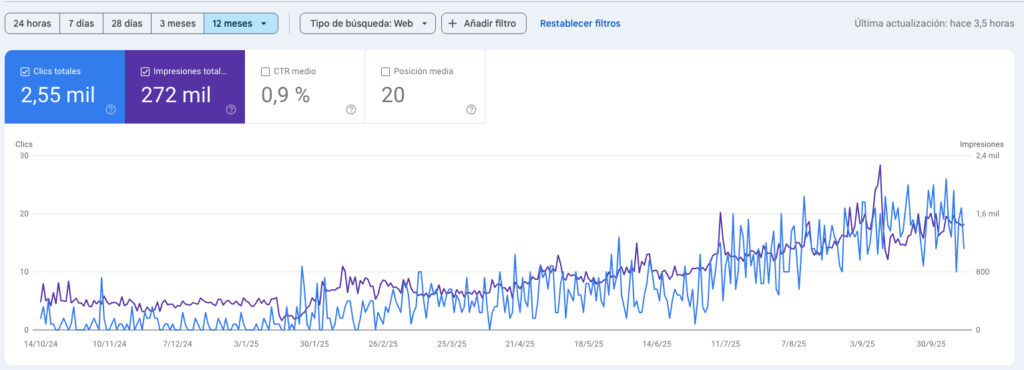
If you are seeing this image, it is no accident: there is strategy, content and a lot of SEO behind it.
We create real success stories by optimising websites that looked stuck.
Let’s be clear. SEO is not a cost, it is an investment with a return if it is aligned with your model.
Starter Plan (Local Essentials): audit, GBP, 1–2 service landing pages, base citations and a review plan. Ideal for businesses starting out or wanting to get organised.
Growth Plan (Local + Content): 4–6 extra pieces a month across service pages, FAQs and an informational cluster; sensible local link building; monthly reporting.
Scale Plan (B2B/Ecommerce): in-depth technical audit, architecture, strategic content, digital PR, CRO experiments and advanced dashboards.
The exact figures depend on competition, starting point and goals. I always propose quarterly milestones: if it cannot be demonstrated, it does not count.
First month: audit, technical quick wins, content strategy and the priority “money landing page”.
Months 2–3: content production and local optimisation; first off-page actions.
Months 4–6: consolidation, clusters and PR; conversion fine-tuning.
Results vary, but my framework is: visible improvements in visibility and clicks within a few weeks if there are quick wins, and solid growth in new business over the quarterly cycle.
Martorell is a city with a significant industrial and commercial base in the Baix Llobregat. With local SEO, businesses in Martorell can win customers from across the county before they find competitors in Barcelona or Terrassa. Most local service searches are settled on Google before anything else happens.
Google’s AI Overviews show AI-generated answers before the organic results. For businesses in Martorell, appearing in them is a real competitive advantage over companies in larger cities. At JRC Web we implement Schema markup and structured content to maximise the chances of appearing in those answers.
The standout sectors in Martorell are automotive (thanks to its proximity to SEAT), logistics, construction and business services. Local retail also has a lot of untapped digital potential. At JRC Web we analyse the specific competition in your sector before designing the strategy.
JRC Web’s plans for small businesses in the Baix Llobregat start from €300/month. They include technical SEO, Google Business Profile optimisation and content. The Premium plan (€1,000/month) adds link building, AI Overviews optimisation and detailed monthly reporting. No lock-in.
Yes. Google Business Profile optimisation is included in all our plans. We work on the main category, services, photos, posts and review management so that your business appears in the local Map Pack for Martorell and in nearby searches across the Baix Llobregat.
Yes. We serve businesses in Martorell, Sant Andreu de la Barca, Abrera, Esparreguera, Olesa de Montserrat and the whole Baix Llobregat county. We also work with companies in the Baix Penedès and the Alt Penedès.
Tell us what you need and we will prepare a quote within 24h.
No obligation. No lock-in.