How much Google Ads costs: spend, management fees and a realistic budget
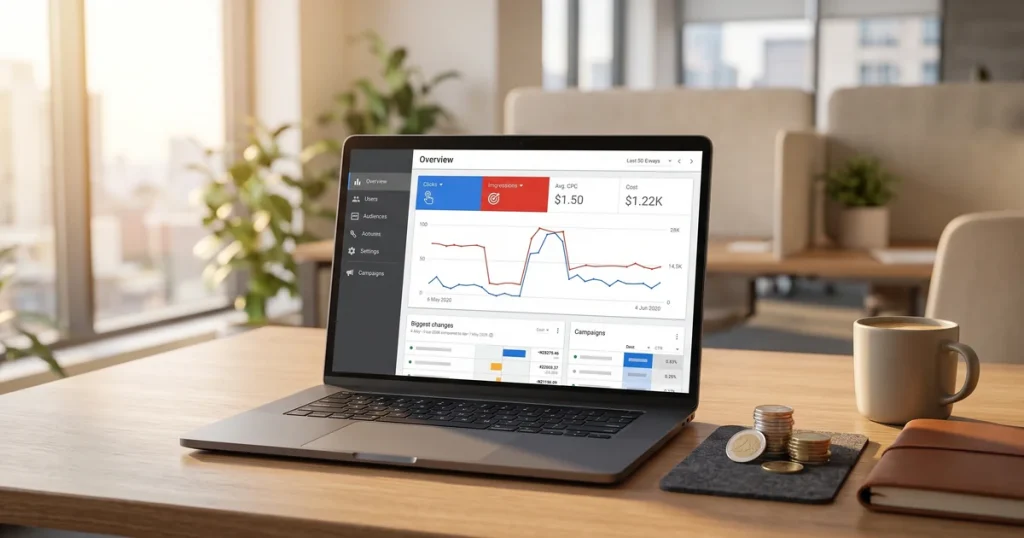
How much Google Ads costs: what you pay Google, what an agency charges to manage it and what budget you need for it to pay off.
Facebook in Spain still works: here is where, how and with which creatives it converts best. If you want to take your digital presence to the next level, at our digital marketing agency we help you get the most out of your campaigns.
If you look at “Facebook in Spain” only through the headline, you miss the nuance: it is not the trendy network, but it still concentrates a lot of reach and, above all, spending power. Across our projects we see three operational truths:
Age distribution: the bulk of paid and organic performance comes from users +30. It is not that younger audiences are not there; it is that they convert less for businesses that are not purely leisure.
Geography: campaigns focused on large urban centres (Madrid, Barcelona, Valencia, Seville, Malaga, Bilbao) and local radii of 10-30 km for SMEs give us a very healthy balance between volume and cost.
Behaviour: Facebook works well for discovery and and consideration if the message lands on a decent landing page; if it does not, a cheap CPC turns expensive.
In our case, when the business has a high average order value or needs explaining (renovations, private healthcare, B2B, professional services), Facebook is still a key channel because we can educate before asking for the lead.
Tendencias actuales
Less purely organic reach; more value in groups and and UGC (user-style content).
Better performance when we combine short video + and sequencing (carousels or collections).
Messaging as a micro-funnel: Click to Messenger/WhatsApp to resolve quick questions.
Yes when:
You can show the result (before/after, testimonials, a short demo).
You have a simple value proposition and a clear landing page (not 8 menus, zero friction).
Your sales cycle allows for warming up: first touch on Facebook, close by email or phone.
No (or with reservations) when:
Your whole margin depends on the last click and you do not measure multi-touch attribution.
The product is hyper-niche and your TAM is tiny: it may pay off more to go with LinkedIn/SEO.
You cannot comply with GDPR and Consent Mode: better to fix the foundations before sending traffic.
As a web design agency, if the client will not agree to optimise the website, we stop. Facebook does not fix broken funnels.
Our base recipe for Spain, which we then adapt by sector:
A simple 3-step funnel
Discovery ad: promise + social proof (before/after, a standout review).
Value content: a short guide or a 30-45s video on how to get started.
Conversion: native lead form or a landing page with one CTA.
Creative sequence
Day 0-3: short video with large subtitles.
Day 4-10: carousel with benefits and cases.
Day 11-20: retargeting with evidence (reviews, logos, guarantees).
Campaign objective and bidding
Traffic only to populate audiences at the start. The core is Conversions (Lead/Purchase) with a 7-day click window.
CAPI + Pixel from day 1 for stable signals.
What works best for us: ads with visual proof + a landing page that loads in under 2s and repeats the same claim as the ad. Whenever we have aligned message and landing, the drop in bounce rate is immediate.
Targeting (quick guide)
Local: a 10-30 km radius + related interests; exclude employees/partners if needed.
1% lookalikes of visitors or buyers (when there is a minimum base).
30-day retargeting with controlled frequency (impression capping).
Creatives
and UGC (a vertical recorded testimonial) beats stock photography again and again.
Before/after on tangible services (renovations, dental, web design) = a scroll-stopper.
Simple motion: large text, 3 bullets, closing CTA.
Copy: be direct; a promise + benefit + proof beats “brand poetry”.
At our web design studio, the mobile mockup with a micro-demo of the site (a recorded scroll) has beaten any static hero for capturing redesign leads.
Architecture: Tag Manager + Consent Mode v2; consent first, then fire Pixel/CAPI.
Minimum events: PageView, ViewContent, Lead o Purchase; add Schedule, CompleteRegistration if relevant.
Micro-conversion alignment: if you ask for WhatsApp, measure click-to-chat as an event.
Speed and UX: CLS under 0.1 and low TTFB on nearby servers; every extra second kills your CPA.
We integrate Pixel/CAPI on WordPress and Shopify with reusable templates and A/B tests of forms (fields and steps). Going from 6 fields to 3 has given us clear jumps in submission rate.
Initial budget: better to start concentrated (one or two campaigns) to force the learning phase.
KPIs by stage:
Discovery: CPC and video view rate.
Consideration: CTR and time on page.
Conversion: cost per lead/sale and close rate in the CRM.
Attribution: look at Meta and and your web analytics. If you believe only one, you lose context.
Operationally, we review creatives every 7-10 days and run landing page sprints in parallel: changing the page moves the result more than tweaking 20 interests.
Local
Objective “Calls/Messages”, restricted schedule, location extensions.
Ads with a map and local social proof (Google reviews).
eCommerce
Catalogue and and DPAs (dynamic ads).
Creatives with price + benefit; retargeting with AddToCart for 14-30 days.
B2B/Services
Native lead form + nurture by email/WhatsApp.
“Problem → solution” pieces and use cases; avoid unnecessary jargon.
On B2B website redesigns, a short lead magnet (a checklist or template) has worked well for us to raise lead quality before the call.
A generic message for the whole country: adapt by city or postcode when the service is local.
A misaligned landing page: if the ad promises X, the page H1 must repeat exactly X.
Forgetting Consent Mode: you will end up without reliable data; fix it before scaling.
Looking only at likes: decide with business data, not vanity metrics.
Meta Ads help centre and blog for product changes.
Professional communities and digital marketing newsletters.
Tag Manager/Consent Mode technical documentation to keep measurement stable.
A short video with a clear promise and social proof + a minimal landing page with a single CTA.
Enough for 100-200 qualified clicks o or 50-100 landing page visits; less than that is noise.
Test both; in Spain, Facebook performs better on +30 and purchase decisions that need more thought.
Click to rate this post!
How useful did you find this content?
Click a star to rate it!
Average rating!0/ 5. Vote count0
No votes yet! Be the first to rate this post.

How much Google Ads costs: what you pay Google, what an agency charges to manage it and what budget you need for it to pay off.

Web design for freelancers in Barcelona: which pages you need, what it costs and how to get a professional, affordable website that wins clients.

What AI search optimisation (GEO) is and how to get ChatGPT, Gemini and Perplexity to recommend your company in Barcelona.