Digital advertising
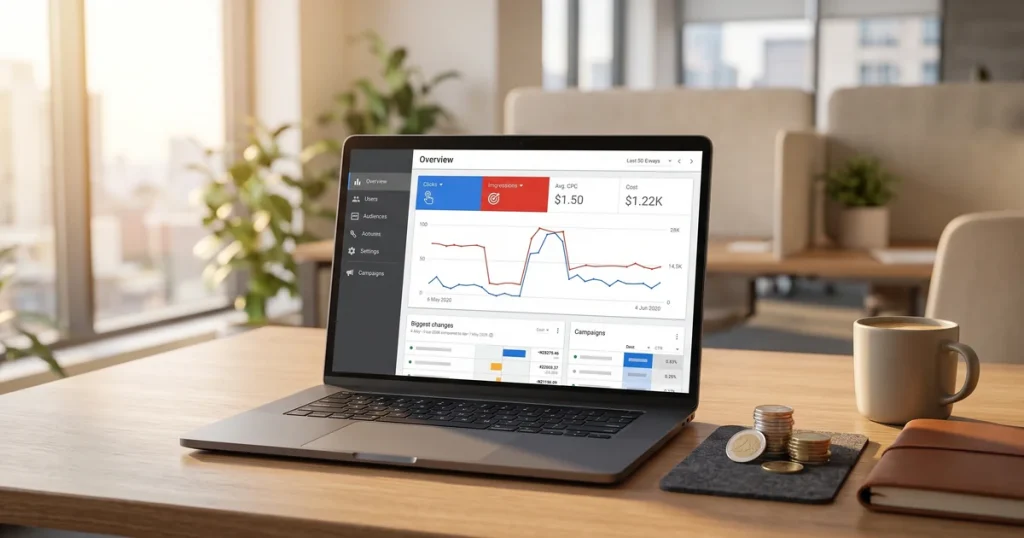
How much Google Ads costs: spend, management fees and a realistic budget
How much Google Ads costs: what you pay Google, what an agency charges to manage it and what budget you need for it to pay off.


Want to know which changes will shape SEO in 2026? Search rankings keep evolving, and this year brings important developments: artificial intelligence, zero-click searches and Google’s new quality criteria are rewriting the rules.
One of the most significant trends is the consolidation of Google’s AI Overviews, which are changing how people find information and how websites gain visibility. Adapting to this new landscape is no longer optional.
In this guide we go through the main SEO trends of 2026, how they affect your strategy and what you can do to keep your site visible. From our search marketing agency, where we work with these changes on real projects every day.
SEO in 2026 is no longer just a matter of keywords and links. Google has evolved into a system that understands context, user intent and genuine content quality.
The most significant changes come from artificial intelligence. Google uses technologies such as RankBrain, BERT and now its Search Generative Experience (SGE) to deliver more precise, personalised answers.
The main changes we will see in 2026:
AI-generated answers directly in the search results. More weight given to the content creator’s experience. Absolute priority for user experience and loading speed. Conversational content tuned for voice search. Local SEO more relevant than ever for businesses with premises.
For any SEO agency or professional in the field, adapting to these changes is essential to maintaining online visibility.
AI is completely transforming how Google interprets and ranks content. Including keywords is no longer enough: the algorithm analyses the full context of your content.
How does that affect your SEO strategy?
Google uses advanced language models to understand the real intent behind each search. That means your content has to answer questions naturally and completely, not just contain specific terms.
How to adapt:
Create content that answers questions exhaustively. Use natural, conversational language. Cover topics in depth rather than superficially. Include data, examples and case studies. Structure the content logically and make it easy to follow.
AI tools can also help you optimise your strategy, from keyword analysis to generating content ideas. The final content, though, must add real value and human experience.
One of the most disruptive trends of 2026 is the rise of zero-click searches. Google increasingly shows direct answers on the results page thanks to its Search Generative Experience (SGE).
According to recent data, more than 60% of Google searches end without the user clicking any result. That is a significant challenge for traditional organic traffic.
How do you adapt to that?
Optimise your content to appear in featured snippets. Use structured data so Google understands your content better. Create content valuable enough that people want to read further. Diversify your traffic sources: YouTube, social media, email marketing. Build your brand so people search for you directly.
The goal is no longer just the click, but being the source Google cites in its generative answers.
E-E-A-T (Experience, Expertise, Authoritativeness, Trustworthiness) has become one of the fundamental pillars of SEO in 2026. Google wants to show content created by people with real experience of the subject.
What does each component mean?
Experience: Has the author actually used the product or lived through the situation described? Google values content based on first-hand experience.
Expertise: Does the author have the necessary knowledge of the subject? That covers training, professional background and specialisation.
Authoritativeness: Is the author or the site a recognised reference in the field? It is measured through mentions, links and online reputation.
Trustworthiness: Is the site secure and transparent? That includes HTTPS, clear policies, verifiable contact details and positive reviews.
To improve your E-E-A-T, add author biographies, cite reliable sources, keep content up to date and earn mentions from authoritative sites in your field.
Core Web Vitals remain a key ranking factor in 2026. Google measures three main metrics that determine the user experience on your site.
The three key metrics:
LCP (Largest Contentful Paint): Measures how long the largest visible element takes to load. The target is under 2.5 seconds.
INP (Interaction to Next Paint): Replaces the old FID and measures the response to user interaction. It should be under 200 milliseconds.
CLS (Cumulative Layout Shift): Measures visual stability. Elements should not move while the page loads. The target is under 0.1.
How to improve your Core Web Vitals:
Optimise images and use modern formats such as WebP. Add lazy loading for off-screen content. Minimise render-blocking JavaScript and CSS. Use good hosting with a CDN. Check your metrics regularly in Google Search Console.
In 2026, more than 60% of global web traffic comes from mobile devices. Google uses the mobile version of your site as its main reference for indexing and ranking.
What does mobile first mean in practice?
Your site must work perfectly on phones, not merely adapt. Navigation has to be intuitive with a thumb. Buttons and links need to be big enough to tap easily. Content must be readable without zooming. Forms must be easy to complete on a touchscreen.
Common mistakes to avoid:
Intrusive pop-ups that cover the content. Elements too small to interact with. Hidden content that only appears on desktop. Excessive loading times on mobile connections. Blocked resources that prevent rendering.
Use Google’s mobile-friendly test to check your site meets current standards.
Voice searches keep growing thanks to assistants such as Siri, Alexa and Google Assistant. In 2026 it is estimated that more than 50% of searches include some voice component.
How is voice search different?
Queries are longer and more conversational. People ask complete questions rather than typing keywords. They want direct, concise answers. There is more local intent: “restaurants near me”.
How to optimise for voice search:
Include natural questions and answers in your content. Optimise for long-tail phrases. Make sure your local business information is up to date. Create content that answers specific questions directly. Use natural, conversational language.
Conversational SEO does not replace the traditional kind, it complements it. You need both to cover every type of search.
Google has declared war on mediocre content. In 2026, quality definitively beats quantity. The Helpful Content Updates penalise content created mainly to rank.
What does Google consider quality content?
Content created for people, not for search engines. Original information based on real experience. Complete coverage of the topic, leaving no questions unanswered. Regular updates to existing content. Clear, verifiable authorship.
What to avoid:
AI-generated content with no human oversight or added value. Superficial articles that bring nothing new. Content duplicated or reworded from other sources. Publishing for the sake of it with no clear strategy. Ignoring older content instead of updating it.
An SEO audit can help you identify content that needs improving or removing.
Local SEO matters more than ever for businesses with premises. Google prioritises local results whenever it detects geographic search intent.
The key local SEO factors in 2026:
An optimised Google Business Profile: Complete information, up-to-date photos, correct opening hours and precise categories.
Reviews and ratings: The number and quality of reviews directly affects local rankings. Always reply to reviews, positive and negative alike.
NAP consistency: Your Name, Address and Phone must be identical across every platform and directory.
Localised content: Create dedicated pages for each location if you have several premises. Include natural local references in your content.
Local links: Earn mentions and links from media, associations and businesses in your area.
Local SEO is especially relevant for an SEO agency in Barcelona and other cities where competition is high.
Visual content takes centre stage in 2026. YouTube is the second most used search engine in the world and Google shows more and more video results in the traditional SERPs.
Why video matters for SEO:
Videos increase time on page. Google shows featured videos for many searches. YouTube offers an additional source of organic traffic. Videos generate more engagement and shares.
Image optimisation:
Use descriptive file names containing keywords. Include relevant alt text. Compress images without losing quality. Use modern formats such as WebP or AVIF. Implement responsive images for different devices.
Video optimisation:
Write titles and descriptions optimised for YouTube. Add transcripts and subtitles. Use attractive thumbnails to raise your CTR. Include timestamps to make navigation easier. Embed relevant videos in your articles.
Featured snippets are the direct answer Google shows above the first organic result. Appearing in position zero can boost your visibility significantly.
Types of featured snippet:
Paragraph: A 40-60 word text answer. Ideal for definitions and explanations.
List: Numbered steps or bullets. Perfect for tutorials and rankings.
Table: Organised comparative data. Useful for prices, specifications or comparisons.
How to win featured snippets:
Identify the questions your audience asks most. Answer directly and concisely in the opening paragraphs. Use the right format: lists for processes, tables for comparisons. Include the question as an H2 or H3 subheading. Make sure your page already ranks in the top 10 for that search.
Not every result has a featured snippet, but where there is one it captures a large share of the clicks.
Links are still an important ranking factor, but in 2026 quality matters far more than quantity. Google keeps getting better at spotting artificial or low-quality links.
What makes a link valuable?
Topical relevance: The link comes from a site related to your field.
Domain authority: The linking site has a good reputation and solid metrics.
Naturalness: The link makes sense in the context where it appears.
Diversity: You have links from different kinds of source.
Effective link building strategies:
Create content others naturally want to link to. Collaborate with other professionals in your field. Take part in interviews and podcasts. Publish original data and research. Answer journalists’ queries (HARO, Connectively).
Avoid buying links, joining link farms or using black hat techniques that can lead to penalties.
structured data help Google understand your content better. In 2026 they matter even more, especially for appearing in rich results and AI answers.
The most important Schema types:
Article: For blog posts and news. Includes author, date and organisation.
LocalBusiness: Essential for local SEO. Includes address, opening hours and contact details.
Product: For online stores. Shows price, availability and ratings.
FAQ: For frequently asked questions sections. It can appear as a rich result.
HowTo: For step-by-step tutorials. Ideal for instructional content.
How to implement Schema:
Use Google’s Structured Data Markup Helper. Plugins such as Yoast SEO or Rank Math make it easy. Validate your markup with the Rich Results Test. Monitor the results in Google Search Console.
Structured data does not guarantee rich results, but it is a prerequisite for them.
Content clusters are a strategy that organises your content around main topics. Instead of isolated articles, you build an interconnected network of content that demonstrates topical authority.
How does a content cluster work?
Pillar page: Long, complete content on the main topic. For example: “The complete guide to SEO”.
Cluster content: More specific articles going deeper into particular aspects. For example: “Technical SEO”, “On-page SEO”, “Link building”.
Internal links: Every cluster piece links to the pillar page and back again, creating an organised structure.
The benefits of clusters:
You show Google you are an expert on the topic. You improve your site’s architecture and navigation. You increase time on site. You spread authority between related pages. You make your content easier to index and understand.
This strategy is especially effective for competing on difficult keywords where you need to prove topical authority.
GEO (Generative Engine Optimization) is the new paradigm emerging in 2026. It means optimising your content to be cited by search engines with generative AI, not just to rank in traditional results.
How does GEO differ from SEO?
Traditional SEO aims to rank your page in the search results. GEO aims to make your content the source the AI cites when it generates an answer. The goal is no longer only the click, but being the reference the AI models use.
How to optimise for GEO:
Include verifiable data, statistics and citable sources. Structure your content clearly and logically. Use Schema markup to make your content easier to understand. Demonstrate real experience and authority on the subject. Keep the content up to date and relevant.
New metrics:
Tools such as Semrush already include a “Share of AI Presence” metric to measure how often your content appears in AI-generated answers. That metric will only grow in importance during 2026.
AEO (Answer Engine Optimization) complements GEO and represents a fundamental change in how we measure SEO success. It is no longer just about ranking, but about being the answer people receive.
The reality of zero-click search:
According to Search Engine Journal’s State of SEO 2026 report, 77.9% of SEO professionals fear losing clicks to AI answers. And they are right: more than 60% of searches already end with no click because Google provides the answer directly.
How do you adapt to AEO?
Optimise for featured snippets (position zero). Create content in question-and-answer format. Use lists and tables Google can extract easily. Build your brand’s authority so you get cited as a source. Diversify your channels: YouTube, social media, podcasts.
Success in 2026 is not measured in traffic alone, but in brand visibility. If Google’s AI cites your content even when the user does not click, you are building authority and recognition.
Adapting to the SEO trends of 2026 takes knowledge, experience and a well-defined strategy. At JRC Web we have spent over 20 years helping businesses improve their online visibility.
What can we do for you?
A full SEO audit to identify opportunities. A content strategy tailored to your sector and goals. Technical optimisation to improve speed and user experience. Quality link building to grow your authority. Monthly tracking and reporting of results.
If you want your website ready for the changes of 2026, get in touch and we will help you define the best strategy for your business.
To keep up with the technical factors Google prioritises, read up on what the Core Web Vitals are and how they affect your website’s rankings.
Yes, SEO remains fundamental to online visibility. Zero-click searches are rising, but appearing at the top of Google is still the most effective way to attract qualified traffic. What changes is how you work at it: quality, user experience and topical authority now come first.
Google’s AI (SGE) generates direct answers in the search results. To adapt, you need to create high-quality content Google wants to cite as a source. That means answering questions clearly, using structured data and demonstrating real experience in your field.
Core Web Vitals are metrics that measure user experience on your site: loading speed (LCP), interactivity (INP) and visual stability (CLS). Google uses them as a ranking factor. A fast, stable site is more likely to rank well than a slow one with technical problems.
In 2026, quality beats quantity. Google penalises superficial or automatically generated content with no added value. One complete, well-crafted article beats several shallow ones. Content must add real value, be based on experience and stay up to date.
GEO (Generative Engine Optimization) and AEO (Answer Engine Optimization) are the new ways of optimising content for AI engines. GEO aims to get your content cited by generative AI. AEO optimises for being the direct answer in zero-click searches. Both complement traditional SEO and will keep growing in importance.
To improve your chances of appearing in AI Overviews you need well-structured content with clear definitions in the opening paragraphs, FAQs with self-contained answers, concrete data (figures, timescales, prices), correct schema markup (Article, FAQPage) and a technically sound site (fast, secure, responsive). Google draws answers from sites that demonstrate experience, authority and trust (E-E-A-T).
Click to rate this post!
How useful did you find this content?
Click a star to rate it!
Average rating!0/ 5. Vote count0
No votes yet! Be the first to rate this post.
How much Google Ads costs: what you pay Google, what an agency charges to manage it and what budget you need for it to pay off.

Web design for freelancers in Barcelona: which pages you need, what it costs and how to get a professional, affordable website that wins clients.

What AI search optimisation (GEO) is and how to get ChatGPT, Gemini and Perplexity to recommend your company in Barcelona.