
Web design
Online Store Design: How to Build an Ecommerce Site That Sells from Day One
Online store design step by step: platform, structure, payments, shipping, legal requirements, SEO and price.

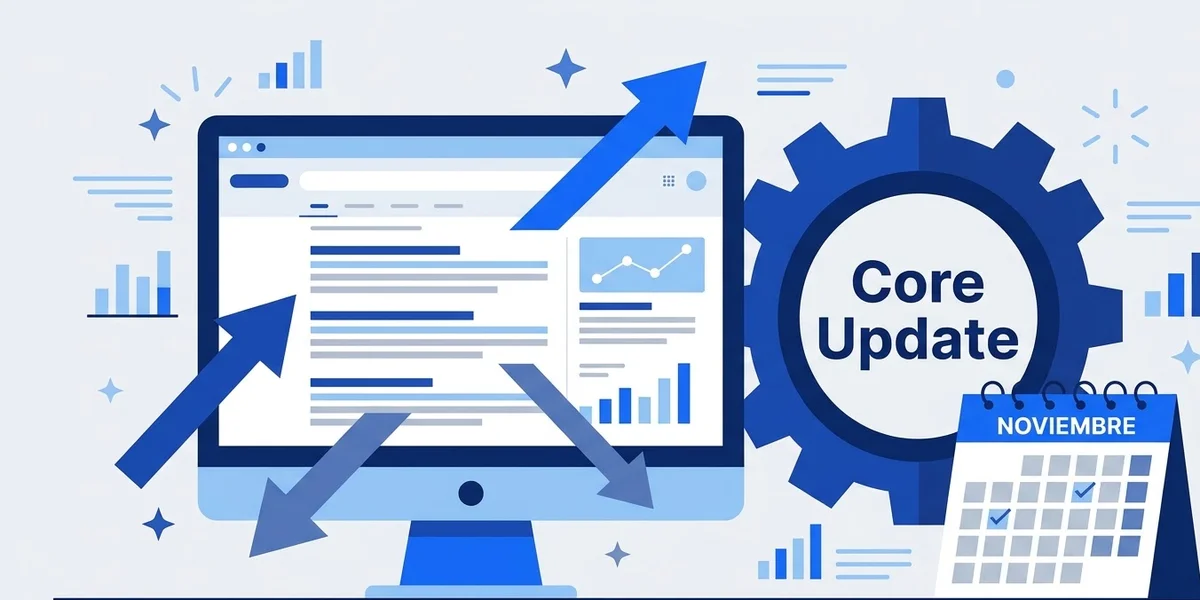
The November 2026 core update is Google’s third broad algorithm update this year: it started on 10 November, will take up to two weeks to roll out and can shift rankings in any sector. If your site has dropped, the first thing any team of technical SEO experts in Barcelona would do is check it in Search Console before changing anything, because these updates also affect which pages Google cites in its AI Overviews.
A core update is a broad update to Google’s main ranking algorithm. It is not aimed at one type of site or one bad practice, as the old updates against spam or paid links were. What it does is review how Google assesses the quality and usefulness of pages in general.
Google usually explains it with a simple comparison: it is like updating a list of the best films. The ones that drop have not suddenly become bad, others are simply valued more highly now. That is why a drop after a core update is not a penalty and no warning appears in Search Console.
Google releases several core updates a year and announces them on its Google Search Status Dashboard, with a start and an end date. While they last, rankings can go up and down several times before they settle.
For a business, the key point is that the change affects the site as a whole: content, user experience, trust and authority signals. There is no single technical fix, and it makes no sense to react on day one, because the data is not reliable yet. The sensible approach is to watch, measure with reliable tools and decide once the rollout has finished.
Google confirmed the start of the November 2026 core update on 10 November, at 10:06 a.m. Pacific time (afternoon in Spain). According to the announcement, the rollout may take up to two weeks, so it should normally finish around 24 November.
As with previous ones, Google has not given specific details about what has changed. Its message is the usual one: the update aims to show useful, reliable content written for people rather than for search engines. There is no list of factors that have become stricter and no manual action attached.
What we do know from experience is how these updates tend to behave. The first few days bring a lot of movement in every sector, with sites rising and falling from one day to the next. From the second week rankings start to settle, and it is not wise to draw conclusions until a few days after Google marks the update as complete.
This is the third core update of 2026, after the March and May ones. If your site already moved in one of them, compare: trends often repeat, and that gives clues about what Google is rewarding in your sector.
A core update arriving in mid November is not good news for many businesses. Black Friday falls on 27 November and, for online stores and businesses selling services, these are the weeks with the most searches of the whole year. Just when the most visits are expected, rankings are in full movement.
This has two practical consequences. The first is that a drop in visits at this time can have several causes at once: the update, competitors spending more on ads, or simply people comparing more before they buy. Each factor needs to be separated before deciding anything.
The second is that this is not the time for big changes on the site. Redesigning pages, changing URLs or rewriting copy in a hurry in the middle of a campaign adds more noise and can make things worse.
If you rely heavily on organic traffic at this time of year, the safest option is to strengthen other channels for a few days, such as Google Ads, customer emails or social media, while the algorithm settles. That way you protect sales without touching your SEO blindly.

The most reliable way to know whether the core update has affected you is to look at your own data, not rumours or third party tools. And it has to be done calmly: a one day drop means nothing during the rollout.
What you are looking for is a sustained change in clicks and impressions from 10 November onwards, compared with an equivalent earlier period. If impressions fall clearly for several days in a row and across many queries at once, that is a sign the update is affecting the site.
It is also worth looking at how the drop is spread. It is not the same if the whole site drops or only a group of pages. If the fall is concentrated in one type of content, for example old blog posts or thin service pages, that is the clue for where to start reviewing.
Finally, rule out other causes before blaming Google: a server outage, an indexing error, a badly configured redirect or a recent change on the site can produce the same effect. On our own site we saw at the end of October how server saturation pushed rankings down for a few days, with no update involved at all.
Search Console is free and it is the most reliable source because it shows real Google data. To review the impact of the core update, follow these steps:
Note down the pages and queries that have lost the most, and look at the same data again one week after the rollout ends. Many drops in the first days recover by themselves, and only the ones that persist deserve work.
If you manage several sites, add an annotation with the start date so you always have it as a reference in future reports.
During a core update, paid SEO tools often show dramatic drops that are later not confirmed. These tools do not see Google’s data: they run automated searches from a specific location and take a snapshot at one moment, right in the middle of the turbulence.
We have seen this on our own site. A rank tracking tool showed us outside the top 100 for one of our main searches, while Search Console showed that same page around position 10. The difference came from the location the query was run from and the moment the data was taken.
Some agencies have published analyses along the same lines: on the first day of an update, trackers detect that a large share of URLs drop out of the top 10, and days later Search Console shows that many of those drops were not real or lasted only hours.
This does not mean the tools are useless. They are helpful for spotting trends and keeping an eye on competitors. But before making decisions, always check against Search Console. If the two do not match, Google’s data is the one that counts.
When you see your site dropping, the natural impulse is to do something fast. During a core update rollout, it is almost always better not to. These are the most common mistakes:
What you can do is keep working as usual: serve your customers, keep the site up to date, fix obvious technical errors and prepare an orderly analysis for when the two weeks are over.
Patience here is not passivity. It is preventing a temporary problem from becoming a permanent one by acting without data.
If the drop persists one week after the rollout ends, it is time to review the site methodically. There is no single trick, but there is a logical order of work:
A professional SEO audit covers all of these points and ranks them by impact, so the effort goes first to what can move your rankings the most.
It is the question we are asked most, and the honest answer is that it depends. The first thing to know is that many sites recover part of what they lost without doing anything, simply because the movements of the first days correct themselves when the rollout ends.
When the drop is real and comes from the quality or usefulness of the content, recovery is not usually immediate. Google has explained that some changes are reflected as it recrawls and reassesses the site, but that deeper improvements are often noticed mainly in the next core update. At the current pace, that means a few months.
As a practical reference:
The important thing is not to give up. Sites that keep improving steadily are the ones that tend to rise in the next update, while those that change everything blindly every time there is movement end up swinging back and forth.
This article is updated with every core update so you have the history at hand. These are the broad updates confirmed by Google in recent months:
Having these dates at hand is very useful for reading your data. If you see a sharp change in Search Console, check whether it matches one of them before looking for other causes. And if your site rose or fell in several in a row, there is probably a pattern worth understanding.
When Google announces the next update we will add it here, with its dates and whatever it has confirmed. You can bookmark this page as a reference.
Not every drop needs an agency. If the fall is small, temporary or explained by seasonality, keeping an eye on Search Console is enough. But there are situations where it is worth having a professional look at it:
An experienced agency can tell noise from a real problem, and prioritises the changes that can move rankings instead of touching everything at once. It also helps you prepare the site for future updates, which is the best way not to depend on every Google change.
We review your Search Console data, find out what has dropped and why, and propose a clear plan of work to recover visibility.
No. A core update does not punish any specific site and leaves no warning in Search Console. Google reviews how it assesses page quality in general, and some pages go up while others go down. If you have lost rankings, there is nothing to remove and no reconsideration to request.
Google said the rollout may take up to two weeks from 10 November 2026, so it should finish around 24 November. It is best to wait a few more days after the completion announcement before drawing conclusions.
Making big changes during the rollout is not recommended. Many drops in the first days correct themselves. The best approach is to wait until it ends, compare data in Search Console and, if the drop persists, review the content and the technical side methodically.
Usually several times a year. In 2026 there have been three: in March, May and November, plus the December 2025 one. Google announces them on its Search Status Dashboard with a start and an end date.
Yes, indirectly. AI Overviews rely on the pages Google considers most useful and reliable, and a core update changes exactly that assessment. If your site gains or loses rankings, its chances of being cited in Google’s AI summaries change too.
Core updates will keep coming several times a year, and the best defence is not reacting to each one but having a site Google wants to show: useful content written by people who know the subject, a real business behind it, a good mobile experience and an error free technical base. With that foundation, updates tend to be an opportunity rather than a threat.
If the November 2026 core update has affected your site, or you want to review it before the next one, at JRC Web we analyse your Search Console data and help you prioritise the changes that really move rankings, for businesses in Barcelona and across Catalonia.
How useful did you find this content?
Click a star to rate it!
Average rating!0/ 5. Vote count0
No votes yet! Be the first to rate this post.
Online store design step by step: platform, structure, payments, shipping, legal requirements, SEO and price.
How to build a Google Ads landing page that converts: structure, message, speed, forms, tracking and price.
What a monthly SEO service includes, which deliverables you should receive every month, what it costs and the signs that it is not working.