Digital advertising
How much Google Ads costs: spend, management fees and a realistic budget
How much Google Ads costs: what you pay Google, what an agency charges to manage it and what budget you need for it to pay off.


Is your website not getting the visits you hoped for? You are not alone. Improving a website’s rankings on Google is a process that takes strategy, patience and concrete action.
The techniques that work for improving your search rankings are also the ones that help you appear in Google’s AI Overviews: quality content, a sound technical structure and demonstrable authority.
In this guide we explain the most effective actions for improving your search rankings. Brought to you by our SEO agency, where we handle the SEO of businesses of every size.
Before you can improve your site’s rankings, it is essential to understand why it is not working. The most common reasons are:
Your site is not indexed: Google cannot show what it does not know about. If your site is new or has technical problems, it may not even be in Google’s index.
Very high competition: Trying to rank for highly competitive keywords without enough authority is like trying to win a marathon without having trained.
Low-quality content: Google rewards content that genuinely helps users. If your site only has generic or copied text, you are not going to rank.
Technical problems: A slow site with no SSL certificate or with crawl errors could be sabotaging all your SEO work.
Lack of authority: If nobody links to your site, Google reads that as a sign your content is neither relevant nor trustworthy.
You cannot improve what you do not measure. Before making any changes, you need to know exactly where you stand and what problems your site has.
A full SEO audit will reveal:
Home → category pages → service/product pages → blog articles linking back to all of the above.
Speed problems: What is slowing your site down and how to fix it.
Duplicate content: Pages competing against each other for the same keywords.
Broken links: Internal and external alike, both damaging the user experience.
Missed opportunities: Keywords you could rank for with a few small adjustments.
You can start with free tools such as Google Search Console and Screaming Frog (the free version covers up to 500 URLs).
The most common mistake is trying to rank for keywords that are too generic or too competitive. If you run a shoe shop in Barcelona, competing for “shoes” is practically impossible.
Look for keywords with buying intent: “buy shoes online Barcelona” gets fewer searches but attracts real customers.
Use long-tail keywords: Longer, more specific phrases face less competition and convert better.
Analyse your competitors: Find out which keywords your competitors rank for and look for gaps you can exploit.
Useful tools: Google Keyword Planner (free), Ubersuggest (freemium) and Semrush (paid but very thorough).
The goal is not to get more traffic, it is to get the right traffic: people who can genuinely become customers.
SEO titles and meta descriptions are your calling card on Google. They are the first thing a user sees and they decide whether or not they click.
Título SEO (Title tag):
Put your main keyword at the start. Keep the title between 50 and 60 characters. Make it appealing and spark curiosity. Every page should have a unique title.
Meta descripción:
Summarise the content in 150-155 characters. Include your keyword naturally. Add a call to action. Set yourself apart from the competition.
Ejemplo práctico:
Bad title: “Home | My Company”
Título bueno: “Zapatería Online en Barcelona | Envío Gratis en 24h | MiZapato”
A good title can double your CTR (click-through rate) without moving your position on Google.
Loading speed is a ranking factor confirmed by Google. On top of that, every extra second of load time pushes your bounce rate higher.
Core Web Vitals are the metrics Google uses to measure the user experience:
LCP (Largest Contentful Paint): The largest element should load in under 2.5 seconds.
FID (First Input Delay): The site should respond to the first interaction in under 100ms.
CLS (Cumulative Layout Shift): Elements should not move around while the page loads.
How to improve your speed:
Compress your images (use WebP). Enable browser caching. Use a CDN to serve content faster. Minify CSS and JavaScript. Choose quality hosting.
You can measure your speed for free with Google PageSpeed Insights.
More than 60% of web traffic comes from mobile devices. Google uses “mobile-first indexing”, which means it evaluates the mobile version of your site first.
What being responsive means:
Your site adapts automatically to any screen size. Text is legible without zooming. Buttons are easy to tap with a finger. Images resize correctly. Menus work properly on mobile.
Errores comunes en móvil:
Text that is far too small. Buttons packed so closely together that they cause accidental taps. Pop-ups that take over the whole screen. Elements that spill outside the viewport. Forms that are impossible to fill in.
Check your site with Google Search Console’s mobile-friendly test and browse it on your own phone to spot any problems.

Google wants to show the most useful content for every search. If your content genuinely helps users, Google will reward you with better positions.
What quality content looks like:
It answers the user’s question in full. It is well structured with headings (H2, H3). It is original, not copied from other sites. It includes data, examples and real-world cases. It is updated regularly.
The E-E-A-T concept:
Google assesses content on: Experience (you have lived what you are describing), Expertise (you are an expert on the subject), Authoritativeness (others recognise you as a reference) and Trustworthiness (your information is accurate and honest).
Consejo práctico:
Before you write, search your keyword on Google and analyse the top five results. Your content needs to be better, more thorough or simply different from what already exists.
Internal links are one of the most underrated SEO techniques. They let you distribute authority across your pages and help Google understand your site’s structure.
The benefits of internal linking:
It helps Google discover new pages. It passes “authority” from one page to another. It improves the user experience. It reduces the bounce rate. It increases time on site.
Buenas prácticas:
Use descriptive anchor text (not “click here”). Link from pages with authority to the pages you want to boost. Build a structure of thematic “silos”. Do not overdo it: 3-5 internal links per 1,000 words is plenty. Make sure every link works.
Estructura recomendada:
Home → category pages → service and product pages → blog articles that link back to all of the above.
Backlinks (links from other websites to yours) remain one of the most important ranking factors. They work like “votes of confidence” that other sites give your content.
You can learn more about this technique in our guide to what link building is.
Types of backlinks:
Natural links: the best kind, earned by creating content so good that others want to link to it. Guest posting links: you write articles on other blogs in exchange for a link. Directory links: useful if they are quality directories in your sector. Brand mentions: sometimes you are mentioned without a link, and you can ask for one to be added.
Calidad vs cantidad:
A link from a national newspaper is worth more than 100 links from abandoned blogs. Google detects and penalises artificial link schemes.
How to get started:
Create linkable content (guides, studies, tools). Reach out to blogs in your sector. Take part in online communities in your niche. Offer testimonials to tools you use.
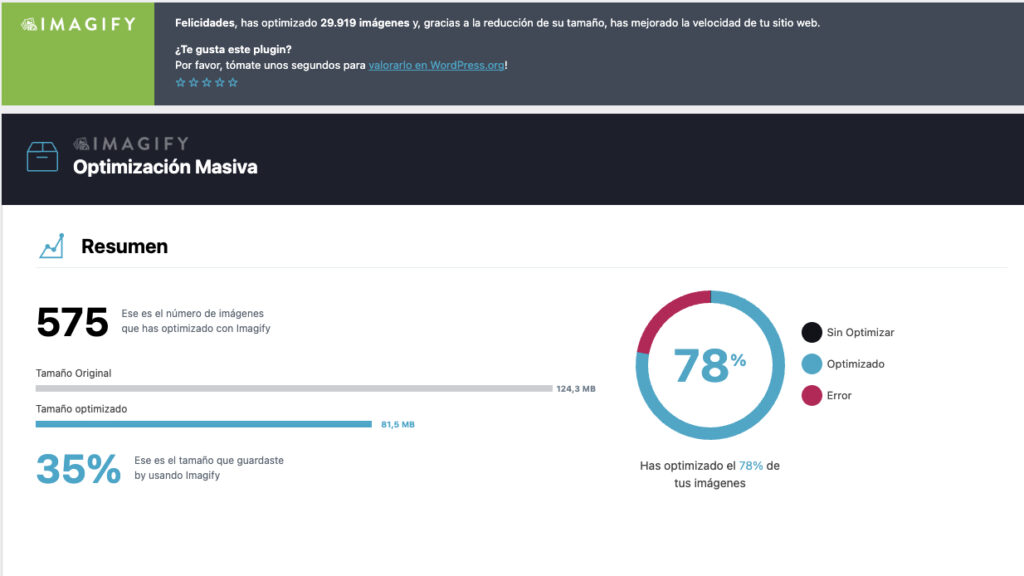
Images can be a significant source of traffic (Google Images) and they can just as easily sink your loading speed if they are not optimised.
Optimización técnica:
Compress images before uploading them (TinyPNG, ShortPixel). Use WebP format wherever possible. Define the dimensions in the HTML. Implement lazy loading. Do not upload images larger than they need to be.
Optimización SEO:
Backlinks (links from other sites to yours) are still one of the most important ranking factors. They are votes of confidence other sites give your content. You can learn more about this in our guide on.
what link building is
Blog images: 1200px wide maximum. Thumbnails: 300-400px. Background images: it depends on the design, but compress them as much as you can.
You do not always have to create new content. Sometimes updating existing articles is a faster, more effective way to improve your rankings.
How long does it take to improve rankings?
Articles that already get some traffic but could get more. Pages sitting in positions 5-20 (close to the top). Content with outdated information. Pages with a good CTR but a high bounce rate.
Does SEO work for every business?
Add new, relevant information. Update old statistics and data. Improve the structure with more H2s and H3s. Add images, videos or infographics. Expand sections that fall short. Remove outdated information.
Frecuencia recomendada:
Review your core content every 6-12 months. Articles with a date in them (“best tools 2026”) need updating annually. Evergreen content can last longer.
Google Search Console is the most important free tool available to any website owner. It tells you exactly how Google sees your site.
What you can do with Search Console:
See which keywords you appear for on Google. Spot crawling and indexing errors. Submit your sitemap. Request indexing for new pages. See which pages have mobile usability problems. Detect security issues.
Métricas clave a revisar:
Impressions: how many times you appear in results. Clicks: how many times people click your result. CTR: the percentage of clicks relative to impressions. Average position: your average ranking for each keyword.
Errores comunes a vigilar:
Pages returning a 404 error. Pages blocked by robots.txt by accident. Core Web Vitals problems. Content flagged as “not indexable”.
Spend 15 minutes a week reviewing Search Console. It will save you a lot of trouble.
If your business has a physical location or serves customers in a specific geographic area, local SEO is essential.
Google Business Profile:
It is free and it is a must. Claim and verify your business profile. Fill in all the details: opening hours, services, photos. Respond to reviews, good and bad. Post updates regularly.
Local SEO factors:
NAP consistency: your Name, Address and Phone number must be identical across the whole site. Reviews: the number, quality and frequency of your Google reviews. Proximity: the closer you are to the person searching, the better. Relevance: your business must match what the user is looking for.
Acciones rápidas:
Add your city to titles and content. Create dedicated pages for each location if you have several. Earn links from local directories and associations in your area. Ask satisfied customers for reviews.
Sometimes what you do NOT do matters as much as what you do. These mistakes can undo all your SEO work:
Errores técnicos:
Blocking Google’s crawler by mistake in robots.txt. Having no SSL certificate (https). Running duplicate versions of the site (www and non-www). Failing to redirect properly when URLs change. Forgetting the sitemap.xml.
Content mistakes:
Copying content from other sites. Keyword stuffing (repeating the keyword excessively). Creating pages with no useful content. Never updating your content. Duplicate titles and descriptions.
Strategy mistakes:
Expecting immediate results (SEO takes months). Buying low-quality links. Ignoring the mobile version. Not measuring results. Making changes without a clear strategy.
If you are making any of these mistakes, fix them as soon as possible. Some can take weeks to put right.
This is the million-dollar question. The honest answer is: it depends. But we can give you indicative timescales based on our experience.
If you want to go deeper, read our guide on how long it takes a website to rank.
Plazos orientativos:
Technical fixes: effects within 2-4 weeks. Optimising existing content: 1-3 months. New content: 3-6 months to rank. Link building: 3-6 months to see results. A brand-new site from scratch: 6-12 months minimum.
The factors involved:
The age of your domain. The competitiveness of your sector. The quality of your content. How often you update. The number and quality of backlinks. The technical health of your site.
Expectativas realistas:
SEO is a medium to long-term strategy. If someone promises you results in weeks, be sceptical. Sustainable results take consistent work over months.
Improving your site’s search rankings takes technical know-how, time and consistency. If you do not have the in-house resources to do it, a professional SEO agency can help.
What we do at JRC WEB:
A full audit of your website. A tailored keyword strategy. Technical and content optimisation. Ethical, effective link building. Monthly results reports.
Why choose us:
More than 20 years of experience in digital marketing. We work with businesses in Barcelona and across Catalonia. If you are in Barcelona, visit our SEO agency in Barcelona page. Tailored strategies, not generic packages. Direct, transparent communication. Measurable, demonstrable results.
If your website is not generating the traffic and customers you need, we can help you turn that around.
One of the factors that carries the most weight in search rankings is the authority you receive from other websites. To dig deeper into how to earn quality links, read our guide on what link building is and the strategies that genuinely work in 2026.
Yes, there are plenty of SEO tasks you can handle yourself: optimising titles, improving content, compressing images and so on. For more complex strategies such as link building or advanced technical audits, though, working with professionals tends to be more efficient.
Costs vary enormously depending on the state of your site and your goals. You can start for free with tools such as Google Search Console. A professional SEO service in Spain typically costs between €300 and €2,000 a month depending on the scope.
SEO works for any business with potential customers searching on Google. The strategy does have to be adapted, though: a local restaurant needs local SEO, whereas an ecommerce site needs product and category SEO.
SEO is not a one-off job. If you stop refreshing content, earning links and maintaining your site technically, competitors will gradually overtake you. You can hold your positions for a while, but in the long run you will lose ground.
They are complementary strategies. Google Ads gives you immediate results, but you pay for every click. SEO takes longer, yet the traffic is “free” once you rank. The ideal approach is to combine the two: Ads for quick results and SEO for sustainable ones.
Does improving my rankings help me appear in Google’s AI answers?
Yes, directly. Google’s AI Overviews draw information from sites already ranking well in the organic results. The better your rankings, the more likely Google is to choose you as a source in its AI answers. Improving your site’s rankings takes technical knowledge, time and persistence. If you do not have the resources in house, a professional If you have checked all of this and your rankings still will not improve, it is time to bring in a professional
At JRC Web we specialise in search rankings and have spent more than 20 years helping businesses improve their online visibility. We run complete SEO audits to identify exactly what is holding your site back.
What can we do for you?
A complete diagnosis of your ranking problems, fixing technical errors, optimising content to improve your positions, a link building strategy to grow your site’s authority, and continuous tracking of results.
How useful did you find this content?
Click a star to rate it!
Average rating!0/ 5. Vote count0
No votes yet! Be the first to rate this post.
How much Google Ads costs: what you pay Google, what an agency charges to manage it and what budget you need for it to pay off.

Web design for freelancers in Barcelona: which pages you need, what it costs and how to get a professional, affordable website that wins clients.

What AI search optimisation (GEO) is and how to get ChatGPT, Gemini and Perplexity to recommend your company in Barcelona.