que es el sem

What Is SEM: The Complete Guide to Paid Search Marketing

Want to appear at the top of Google straight away? SEM (Search Engine Marketing) gets you there through paid advertising in search engines. Unlike SEO, which takes months of work, SEM can bring you visits from day one. At our Google Ads agency in Barcelona we run profitable campaigns from the very first month. In this guide we explain what SEM is, how it works, its advantages over other digital marketing strategies, and how to implement it properly for profitable results.

What you will learn in this guide

  • What SEM is: Search engine marketing
  • How it works: The auction system and pay per click
  • The main platforms: Google Ads, Microsoft Advertising
  • The advantages of SEM: Why use it in your strategy
  • SEM vs SEO: When to use each

Contents

What is SEM?

SEM (Search Engine Marketing)is the set of digital marketing strategies that use paid advertising to increase a website’s visibility in the search results.

Technically SEM covers all search engine marketing (including SEO), but in industry practice it is mainly used to mean paid advertising on platforms such as Google Ads or Microsoft Advertising.

Where do SEM ads appear?

  • At the top of the results: Marked “Sponsored” or “Ad”
  • At the bottom of the results: After the organic results
  • In the side panel: For some kinds of search (Shopping, Maps)

SEM lets companies buy instant visibility, appearing for specific searches when users have purchase intent or are looking for relevant information.

How SEM works

SEM works through a real-time auction system. Every time someone searches, an instant auction decides which ads to show and in what order.

The auction process

  1. The user searches: They type a query into Google
  2. Advertisers are triggered: Those who bid on those keywords
  3. Google evaluates: Bid, ad quality and relevance
  4. Ads are shown: The winners appear in the results
  5. The user clicks: The advertiser pays the cost per click

The highest bidder does not simply win

Google weighs several factors besides money:

  • Quality Score: A quality rating for the ad (1-10)
  • Relevance: Does the ad match the search?
  • Landing page experience: Is the destination page useful?
  • Expected CTR: Are users likely to click?

A high-quality ad can beat one with a higher bid, and pay less per click into the bargain.

Payment models in SEM

The most common payment model in SEM is PPC (Pay Per Click) . You only pay when someone clicks your ad, not for showing it.

Payment models in SEM

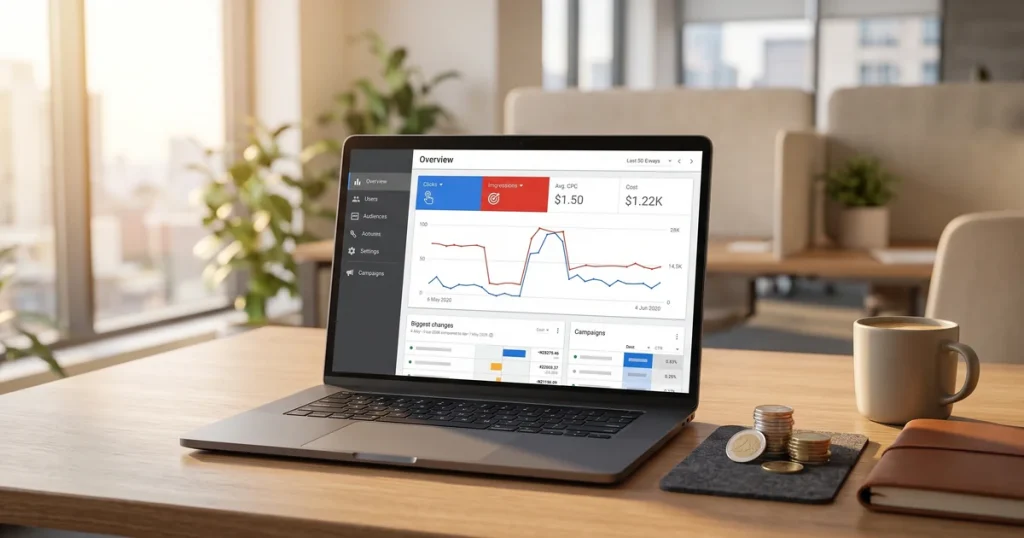
  • CPC (Cost Per Click): You pay for every click received. The most used in search campaigns.
  • CPM (Cost Per Thousand Impressions): You pay for every 1,000 times your ad is shown. Common in Display.
  • CPA (Cost Per Acquisition): You pay per conversion. It needs historical data.
  • CPV (Cost Per View): You pay per video view. Used on YouTube.

How much does a click cost?

CPC varies enormously with the sector and the competition:
  • Low-competition sectors: €0.10 – €0.50
  • Mid-range sectors: €0.50 – €2
  • Competitive sectors: €2 – €10
  • Very competitive sectors (insurance, legal, finance): €10 – €50+
que es el sem

The main SEM platforms

Google Ads dominates the SEM market, but there are other platforms that may matter to your strategy:

Google Ads

The leading platform, with more than 90% market share in Spain. It covers search, Display, Shopping, YouTube and more. It is where any SEM strategy should start.

Microsoft Advertising (Bing Ads)

Ads on Bing, Yahoo and DuckDuckGo. Lower volume, but also less competition and lower CPCs. Worth adding as a complement, especially for B2B.

Amazon Advertising

If you sell products on Amazon, its advertising platform is essential. Amazon users have high purchase intent.

Other platforms

They are not technically SEM (they are not search engines), but platforms such as Meta Ads (Facebook/Instagram) and LinkedIn Ads complement digital marketing strategies with different targeting goals.

The advantages of SEM

SEM offers advantages other digital marketing strategies cannot match:

Immediate results

Unlike SEO, which can take months to produce results, SEM brings traffic from day one. Ideal for launches, promotions or whenever you need results quickly.

High purchase intent

People searching on Google have an active need. They are looking for solutions, not browsing passively. That translates into higher conversion rates than other channels.

Total control

You decide how much to spend (daily and monthly budget), when to show ads (days, hours), to whom (location, language, device) and for which searches (keywords).

Precise measurement

You know exactly which keywords, ads and campaigns deliver results. You can calculate ROI accurately and optimise continuously.

Scalability

If something works, you can increase the budget and scale the results. If it does not, you can pause immediately with no long-term commitment.

SEM vs SEO: the key differences

Understanding the difference between SEO and SEM is essential for knowing when to use each:

SEM (paid advertising)

  • Immediate results
  • You pay for every click
  • Traffic stops when you stop paying
  • Total control over when and where you appear
  • Your listing is marked “Sponsored”

SEO (organic rankings)

  • Results in the medium to long term (3-12 months)
  • You do not pay per click (you invest in content and optimisation)
  • The results last over time
  • You depend on Google’s algorithm
  • Users perceive it as more credible

Which should you choose?

They are not mutually exclusive. The most effective strategy usually combines both: SEM for immediate results while SEO develops. Over time, SEO can carry more of the load and reduce your dependence on paid advertising.

Keywords in SEM

SEM is one of the most effective ways of winning customers while they are actively looking for what you offer. Running profitable campaigns, though, takes experience, time and knowledge not every company has in house.

At JRC Web we offer full SEM campaign management. We do not just create and optimise campaigns; we focus on what really matters: making every euro invested deliver the maximum possible return.

As a digital marketing agency in Barcelona, we combine SEM with SEO so your business has a complete presence in the search results, both paid and organic.

Want to start with SEM or improve your current campaigns? Get in touch and we will review your case with no commitment.

How to write effective ads

Keywords are the heart of SEM. Choosing the right ones decides whether your campaign is profitable or a waste of money.

Match types

  • Broad match: Google shows your ad for related searches. More reach but less control.
  • Phrase match: The search must contain your phrase. A balance between reach and relevance.
  • Exact match: Only searches very similar to your keyword. Maximum control, less reach.

Negative keywords

Just as important as the positive ones. They exclude irrelevant searches so you do not waste budget. For example, if you sell “in-person English courses”, add “free” and “online” as negatives.

Keyword research

Good keyword research is fundamental. Use the Google Ads Keyword Planner to find relevant keywords, see volumes and estimate costs.

Why the landing page matters

Writing effective ads is an art. You have limited space to convince someone to click your ad rather than the others.

The structure of a search ad

  • Headlines: Up to 3 headlines of 30 characters each
  • Descriptions: Up to 2 descriptions of 90 characters
  • Display URL: Your domain plus customisable paths
  • Extensions: Extra links, phone number, location and so on

Tips for effective ads

  • Include the keyword: In the main headline whenever it reads naturally
  • Lead with benefits: Not features, but what the user gains
  • Use numbers: Prices, percentages, concrete timescales
  • A call to action: “Request a quote”, “Buy now”, “Find out more”
  • Create urgency: “Limited offer”, “Today only”, “Last places”
  • Test variants: Google lets you create several ads and picks the best performers

Measurement and conversion tracking

The landing page matters as much as the ad. You can have the best ad in the world, but if the landing page does not convince, you have paid for the click for nothing.

What makes a good landing page

  • Relevance: The content must match what the ad promised
  • Speed: Fast loading, especially on mobile
  • Clarity: A clear message with no unnecessary distractions
  • A visible CTA: A clear, prominent action button
  • Trust: Testimonials, client logos, guarantees
  • Simple forms: Only the fields you really need

The effect on Quality Score

Google assesses the landing page experience. A slow, irrelevant page with a poor user experience lowers your Quality Score, which means paying more per click and appearing in worse positions.

Professional, conversion-oriented web design makes a big difference to the ROI of your SEM campaigns.

Common SEM mistakes

Without proper measurement, SEM is like throwing darts blindfolded. Conversion tracking is essential.

What counts as a conversion?

A valuable action you want the user to take: a purchase, a form submission, a phone call, a download, a sign-up. It depends on your business model.

How to set up tracking

  • The Google Ads tag: Code you install on your site to track conversions
  • Google Analytics 4: Connect GA4 to Google Ads to import conversions
  • Call tracking: For businesses where the phone matters

Key SEM metrics

  • CTR (Click Through Rate): The % of users who click versus impressions
  • CPC (Cost Per Click): What you pay on average for each click
  • Conversions: The number of valuable actions achieved
  • CPA (Cost Per Acquisition): The average cost of each conversion
  • ROAS (Return On Ad Spend): Revenue generated per euro invested

Frequently asked questions about SEM

Not quite. SEM (Search Engine Marketing) is the general concept of marketing on search engines through paid advertising. Google Ads is Google’s specific platform for doing SEM. It is like saying that ‘instant messaging’ is the concept and ‘WhatsApp’ is one specific platform.
There is no compulsory minimum, but to gather meaningful data we recommend starting with at least €300-500/month in less competitive sectors. In highly competitive sectors you may need more. What matters is having enough budget to generate data and optimise.
Not directly. Google has confirmed that running ads neither improves nor harms your organic rankings. SEM can help indirectly, though: conversion data helps you prioritise keywords for SEO, and the extra visibility can generate more branded searches.
You can do it yourself. The platform is accessible and there are plenty of training resources. Optimising campaigns for a good ROI, though, takes experience and time. Many businesses start in-house and bring in professionals once they see they are not getting the results they hoped for.
Ads start showing within hours. Real optimisation, however, takes at least 2-4 weeks of data. Google needs to learn what works, and you need to analyse the results in order to fine-tune keywords, ads and bids. The first few days are a learning period.

Click to rate this post!

How useful did you find this content?

Click a star to rate it!

Average rating!0/ 5. Vote count0

No votes yet! Be the first to rate this post.

More News