
Digital advertising
How much Google Ads costs: spend, management fees and a realistic budget
How much Google Ads costs: what you pay Google, what an agency charges to manage it and what budget you need for it to pay off.

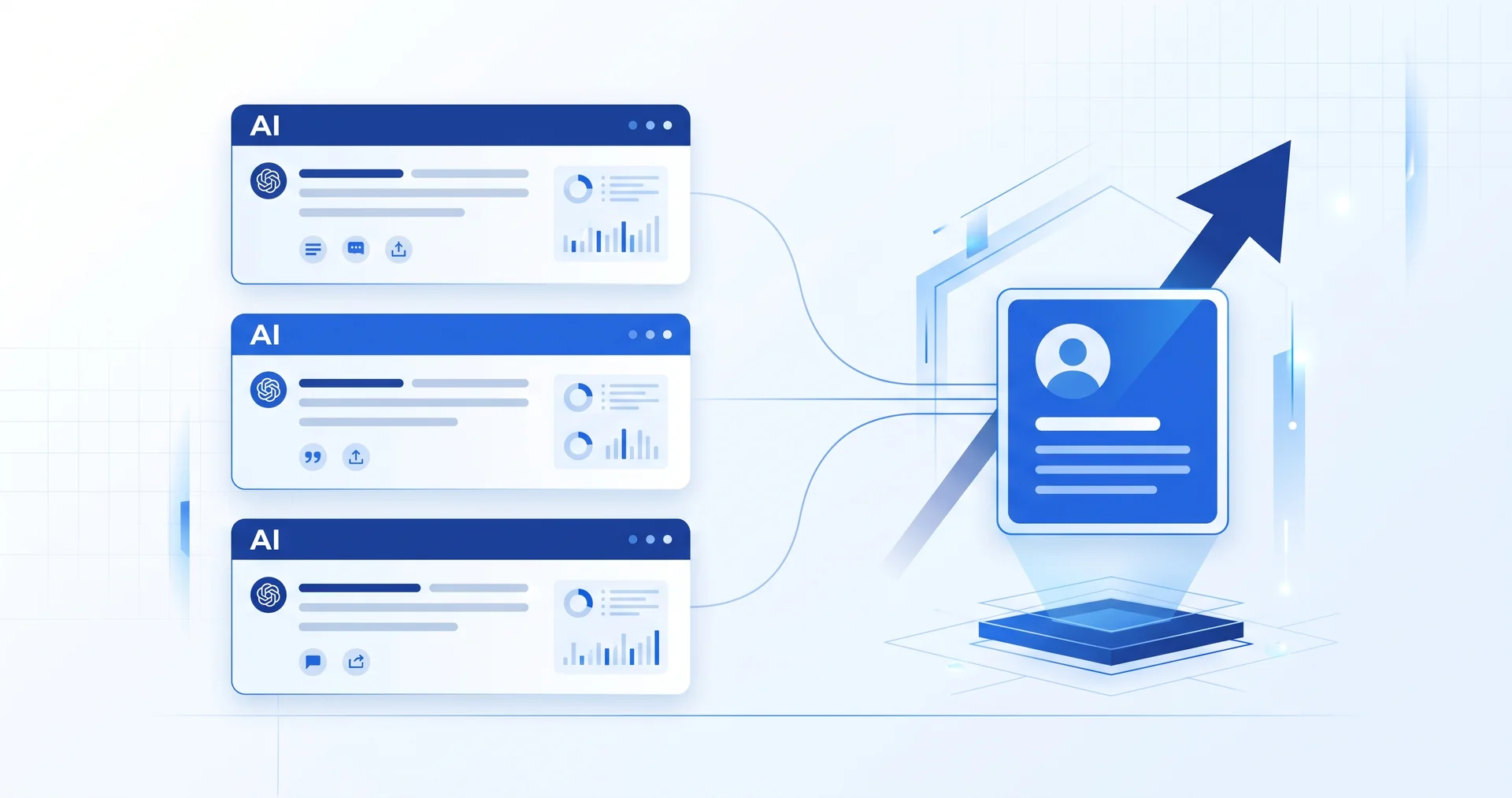
AI search optimisation, or GEO, is the set of actions that get artificial intelligence to cite and recommend your company when someone asks it about a service like yours. Appearing in Google is no longer enough: you also have to appear in the answers from ChatGPT, Gemini or Perplexity and in AI Overviews. You get there with clear content, a site search engines understand properly and brand authority. As search marketing specialists in Barcelona, we prepare your business so the AI finds it, understands it and recommends it.
AI search optimisation, known as GEO (Generative Engine Optimization), is the set of strategies that get a company to appear, be mentioned and be cited in the answers produced by tools such as ChatGPT, Gemini or Perplexity. Instead of competing for a place among ten links, you compete to be one of the few sources the AI considers reliable enough to answer with.
The underlying change is in user behaviour. More and more people do not look for a list of websites; they ask a question and expect a direct answer. If your company is not in that answer, it ceases to exist for a growing share of your potential customers. GEO works on the site, the content, the data and the reputation so AI systems understand who you are, what you offer and why they should recommend you. It is not a passing fad but the natural evolution of online visibility.
SEO aims to get your site into Google’s top results. GEO aims to get your company understood, cited and recommended by artificial intelligence. They are not rivals: they are two layers of the same visibility strategy.
The practical difference is the objective. In SEO you optimise for a ranking algorithm; in GEO you optimise so a generative model can interpret your content and use it in its answer. Many of the foundations are shared: a fast, well-structured site with useful content and authority. But GEO adds new demands, such as answering specific questions self-sufficiently or strengthening brand mentions in external sources.
The conclusion is clear: GEO does not replace SEO, it extends it. A good SEO base is still essential, because without crawling, indexing and authority the AI cannot find you either. The smart move is to work on both at once, since the actions reinforce each other and multiply your presence in both search and generated answers.
When someone asks an AI about a company or a service, the system does not look at a single headline. It analyses the whole set of signals around your brand to decide whether to mention you:
In other words, the AI looks for sources that are reliable and easy to interpret. It does not reward whoever repeats the most keywords, but whoever conveys trust and context. That is why GEO works on the technical side, the content and the brand’s external reputation at the same time.
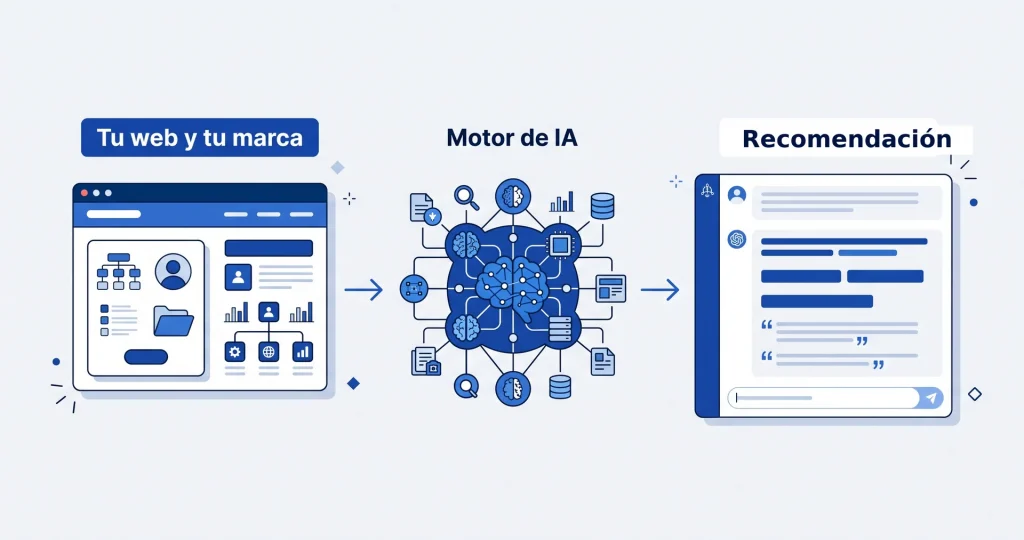
There is no single place to rank: there are several AI engines and each works differently. These are the ones where the queries are concentrated today:
ChatGPT is the most used and gives a lot of weight to content clarity and brand mentions. We explain it in detail in our guide on how to appear in ChatGPT.
Gemini, Google’s AI, relies on the search engine’s index, so your organic position counts for a lot.
Perplexity always shows its cited sources with a direct link, so being cited brings qualified traffic.
And Google’s AI Overviews are the AI summary appearing in the search engine itself. The good news is that the basis for ranking in all of them is the same: clear content, structured data and authority. Working on all four at once is what gives you a solid presence in AI search.
The AI does not reuse whole pages, it extracts fragments that stand on their own. For it to use you as a source, your content has to be easy to extract and to verify:
If a paragraph needs the rest of the article to be understood, it is no use to the AI. Writing this way also improves your traditional SEO, because Google rewards clear, well-structured content too. Writing so a machine can cite an isolated fragment, complete in meaning and backed by data, is one of the most profitable keys to AI search optimisation.
If an AI system cannot crawl or properly understand your site, it will not consider you however good your content is. The technical basis of GEO includes:
It is the least glamorous part and, at the same time, the part that decides whether artificial intelligence can interpret you. Clear architecture, well-implemented structured data and a healthy site are the foundations on which content and authority then work.
When several companies offer the same thing, the AI does not choose the one with the best-written website but the one that conveys the most trust. And that trust is built mostly outside your page, following the principle of experience, expertise, authoritativeness and trustworthiness (E-E-A-T):
It is not only about having a well-built site, but about the internet talking about your brand consistently. Authority cannot be bought or improvised: it is a pattern sustained over time that turns your company into a source artificial intelligence considers worth recommending over the competition.
The way people search has changed. It used to be SEO agency Barcelona; now people ask something like which agency suits me if I have a small online store in Barcelona on a tight budget. The AI understands long questions with context and intent.
That means adapting your content to natural language, working on frequently asked questions, answering real doubts and using the expressions your customer uses. Many of these searches also end in zero clicks: the user gets the answer without visiting any site. Even with no click, being cited still has value, because it reinforces your brand and leads many users to search for you by name afterwards.
Writing for this new landscape means thinking about the full question your customer will ask and answering it better than anyone. Those who do gain visibility both in AI answers and in traditional search, which look more alike every day.
If you have a local business, the AI can also recommend you when someone looks for a service in their area. And here Barcelona and Catalonia have their own rules:
We work daily on rankings for companies in Barcelona, Igualada, Terrassa, Sabadell and across Catalonia. The combination of an optimised listing, reviews, local signals and a well-structured site is what gets a business showing up when artificial intelligence recommends nearby options. The added advantage is that very few companies in the area are working on GEO yet, so whoever starts now has a clear head start.
Before putting effort in it is worth knowing where you stand, and afterwards checking whether the work is paying off. These are the practical ways to measure it:
There are AI visibility monitoring tools that automate part of this tracking, though reliability still varies. What matters is taking an initial snapshot and repeating the measurement regularly, because GEO is progressive work whose results are clearest when compared over time.
An actionable summary to start with AI search optimisation today:
What does it cost? It depends on the state of your site and your sector, just as with traditional SEO, and it makes sense to integrate it into an ongoing search strategy rather than treating it as an isolated action. Starting as soon as possible is key, because competition to appear in AI answers is only going to increase.
We work on your visibility in ChatGPT, Gemini, Perplexity and Google’s AI Overviews, with a measurable plan and no minimum terms.
SEO works on your site’s visibility in Google’s results, while GEO (AI search optimisation) aims to get your company understood, cited and recommended by tools such as ChatGPT, Gemini or Perplexity. They share many foundations, but GEO adds specific work on content, entities and authority.
No. A good SEO base is still essential so your pages can be crawled, indexed and found. GEO builds on that base and extends it towards the new forms of search. The effective approach is to work on both at once, because the actions reinforce each other.
No one can guarantee a specific mention, just as nobody can guarantee first place in Google. What can be done is to improve, measurably, the accessibility, clarity, relevance and authority of your information so the odds of the AI considering and citing you rise sharply.
It depends on the competition, your brand’s existing authority and the scope of the improvements. Some technical and content changes can show within weeks, while building authority is progressive work over several months. It is an ongoing strategy that needs implementation, tracking and updating.
Yes. AI Overviews are the AI-generated summary Google shows in its results, and they are part of the same work. Optimising your site to be citable, with clear content, data and structure, helps you appear both in AI Overviews and in assistants such as ChatGPT, Gemini or Perplexity.
AI search optimisation is not a one-off trick but the consequence of a well-built site, clear and citable content and a brand with authority. Businesses that start working on it now will have the advantage when AI search becomes the norm. If you want your company to be one of those artificial intelligence chooses and recommends, JRC Web can help you get there.
How useful did you find this content?
Click a star to rate it!
Average rating!0/ 5. Vote count0
No votes yet! Be the first to rate this post.
How much Google Ads costs: what you pay Google, what an agency charges to manage it and what budget you need for it to pay off.

Web design for freelancers in Barcelona: which pages you need, what it costs and how to get a professional, affordable website that wins clients.

Learn how to appear in Perplexity and get AI to cite your business: PerplexityBot, citable content, authority and local SEO in Barcelona.