
Digital advertising
How much Google Ads costs: spend, management fees and a realistic budget
How much Google Ads costs: what you pay Google, what an agency charges to manage it and what budget you need for it to pay off.

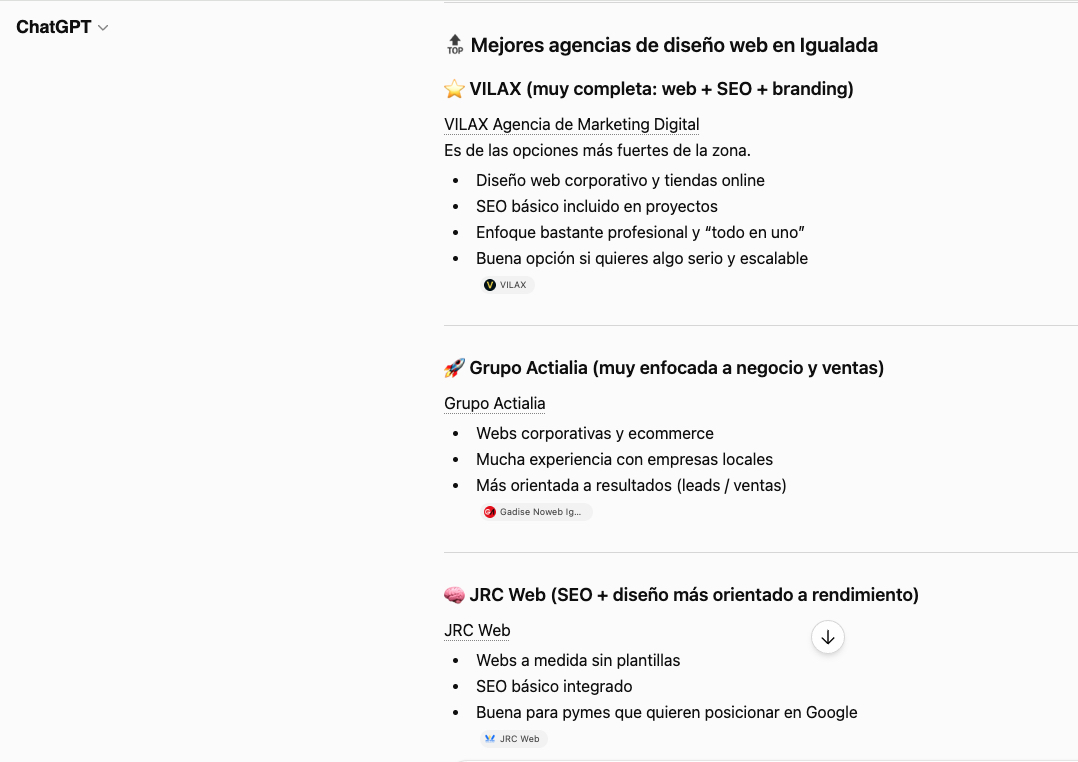
Appearing in ChatGPT means getting the AI to cite your site as a source when someone asks about your product, your service or a business like yours. Ranking first on Google is no longer enough: more and more people resolve questions and compare options inside the chat, and if your brand is not there, it is not part of the conversation.
The good news is that it is not a matter of luck. You can prepare your site so the AI understands it, trusts it and recommends it. In this guide you will see, step by step, what influences that decision and what you can do today to gain visibility in ChatGPT and other models such as Gemini, Perplexity and Copilot.
We give you the concrete essentials based on the experience of our SEO agency in Barcelona, where we have spent more than two decades ranking companies across Catalonia.
Appearing in ChatGPT means the model mentions or links to you as a source when someone asks it about a product, a service or a business like yours. This is a new channel: the user no longer clicks through ten results but receives a direct answer in which your brand appears… or does not.
The goal, then, is not only ranking in Google but getting the AI to recognise you as a reliable source. Whoever starts working on it now will have a head start when AI search becomes the norm.
ChatGPT does not crawl the internet the way Google does. It runs on a model trained on huge volumes of text up to a particular date and, when it needs current information, it connects to the web. And here is the key: for those real-time searches it uses Bing’s index, Microsoft’s search engine.
What does that mean for you? That if you want to appear in ChatGPT, your site has to be indexed and ranking well in Bing, not just in Google. Registering your site in Bing Webmaster Tools (you can import it straight from Google Search Console) is one of the first steps. From there, the model picks the clearest, easiest-to-interpret content as its sources.
These three concepts often get mixed up. They complement each other, but they pursue different goals:
SEO (search engine optimisation): aims to get your site into Google and Bing’s results. It is the base everything else is built on.
AEO (answer engine optimisation): aims to be the direct answer to a specific question, like featured snippets or position zero.
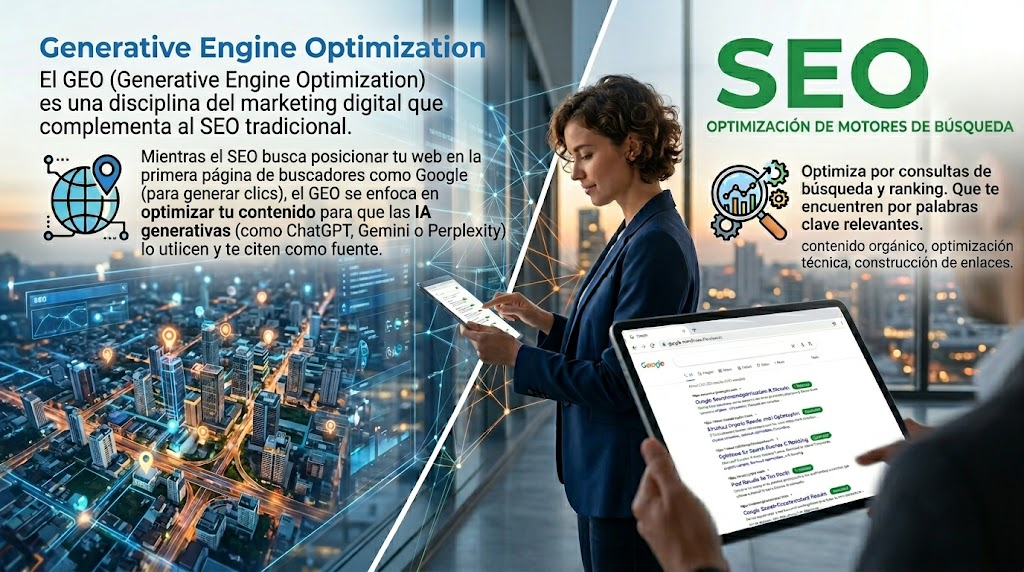
GEO (generative engine optimisation): aims to get models such as ChatGPT, Gemini or Perplexity to cite you as a source in their answers.
How do they relate? SEO is still the foundation: without indexed content and authority, neither AEO nor GEO works. Appearing in ChatGPT is really GEO built on a solid SEO base.
It is worth not confusing two things that sound similar. AI Overviews are the summaries Google shows at the top of its results; appearing in ChatGPT, by contrast, means being mentioned by OpenAI’s chat . They are different ecosystems: AI Overviews draw on Google’s index, ChatGPT on Bing’s.
The underlying work overlaps: clear content, a question-and-answer format, structured data and brand authority help on both fronts. To understand the first properly, we explain it in detail in our guide to Google’s AI Overviews. Working both channels at once multiplies your presence in AI search.
For an AI model to cite you, it first has to be able to read your site. These are the technical settings that make the difference:
None of these is complex on its own, but together they decide whether the AI can interpret you. It is the least glamorous part and, at the same time, the most decisive.
AI models do not judge design: they judge how your content is written and organised. The sites that get cited most share a clear pattern:
If your content answers the question before dressing it up, the AI finds it far easier to reuse. This way of writing also improves your classic SEO: it is the same logic that wins Google’s featured snippets.
The AI does not only look at your site: it looks at what the rest of the internet says about you. The more consistent your presence in reliable sources, the more likely it is to recognise you as a reference.
An isolated mention does not move the needle. What works is a repeated pattern: different sources talking about you consistently. That is what turns a brand into a recommendable source.
If you have a local business, ChatGPT will also recommend you when someone looks for a service near their location. And here Barcelona and the rest of Catalonia have their own rules:
At JRC Web we work daily on local rankings for companies in Barcelona, Igualada, Terrassa, Sabadell, Badalona and across Catalonia: the combination of an optimised listing, reviews and local signals is what gets a business showing up both in Maps and in AI answers.
Before putting effort in, it is worth knowing where you stand. These are the practical ways to check whether ChatGPT already has you on its radar:
Taking this initial snapshot lets you measure progress and focus your work on the questions where you want to appear, instead of working blind.
Many sites do not appear in ChatGPT because of avoidable errors. These are the most frequent:
Fixing these points usually produces quick results, because you are not competing to create something new: you are simply getting out of your own way.
To finish, an actionable list to start today:
What does it cost? It depends on the state of your site and your sector, just as with traditional SEO, and it makes sense to integrate it into a wider search strategy. You can look at our SEO pricing to get an idea of the investment and what each plan includes.
At JRC Web we prepare your site so artificial intelligence finds you, understands you and recommends you. If you want to be one of the sources the AI chooses, we can help you get there.
There is currently no paid route to having ChatGPT recommend your business organically. OpenAI has announced advertising, but recommendations within the answer depend on your visibility, your authority and how well optimised your site is.
Yes. ChatGPT relies on content that is indexed and ranking, above all in Bing. Without a solid base of technical and content SEO, it is very hard for the AI to select you as a source.
There is no fixed timescale. Technical and indexing improvements in Bing can show within a few weeks, while brand authority and mentions are built over months, just as in SEO.
When ChatGPT needs up-to-date information, it searches through Bing’s index, Microsoft’s search engine. That is why it is essential for your site to be indexed and ranking in Bing too.
No. AI Overviews are summaries Google shows using its own index, while appearing in ChatGPT means being cited by OpenAI’s chat, which uses Bing. The optimisation work overlaps, but they are different channels.
Three things are needed for artificial intelligence to recommend a company: a site that is accessible and well structured for its crawlers, clear content in a question-and-answer format, and brand authority built through reviews, mentions and reliable directories.
Appearing in ChatGPT is neither magic nor a one-off trick: it is the consequence of a well-built site, clear content and a brand with authority. Businesses that start working on it now will have the advantage when AI search becomes the norm. If you want your site to be one of the sources artificial intelligence chooses and recommends, JRC Web can help you get there.
How useful did you find this content?
Click a star to rate it!
Average rating!0/ 5. Vote count0
No votes yet! Be the first to rate this post.
How much Google Ads costs: what you pay Google, what an agency charges to manage it and what budget you need for it to pay off.

Web design for freelancers in Barcelona: which pages you need, what it costs and how to get a professional, affordable website that wins clients.

What AI search optimisation (GEO) is and how to get ChatGPT, Gemini and Perplexity to recommend your company in Barcelona.