
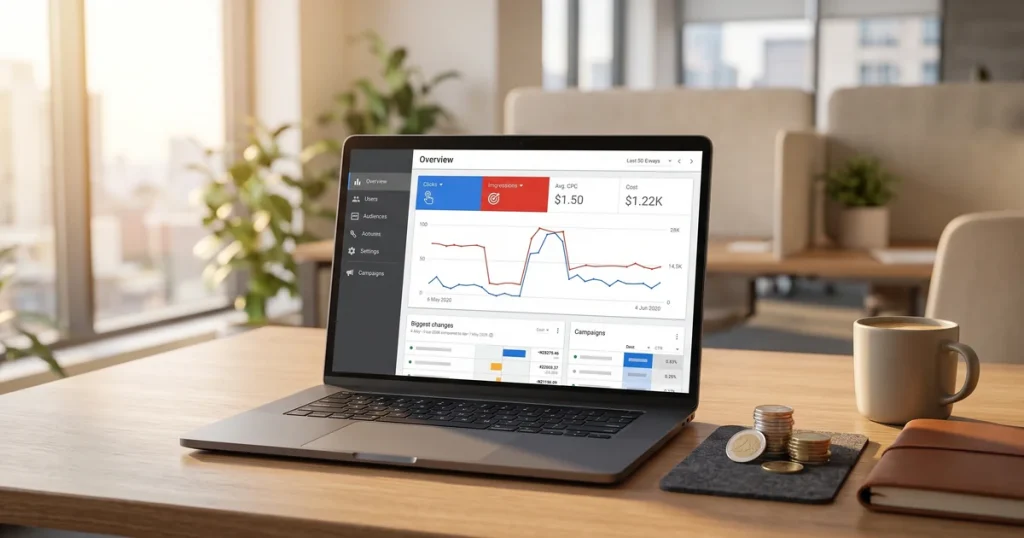
How much Google Ads costs: spend, management fees and a realistic budget
How much Google Ads costs: what you pay Google, what an agency charges to manage it and what budget you need for it to pay off.
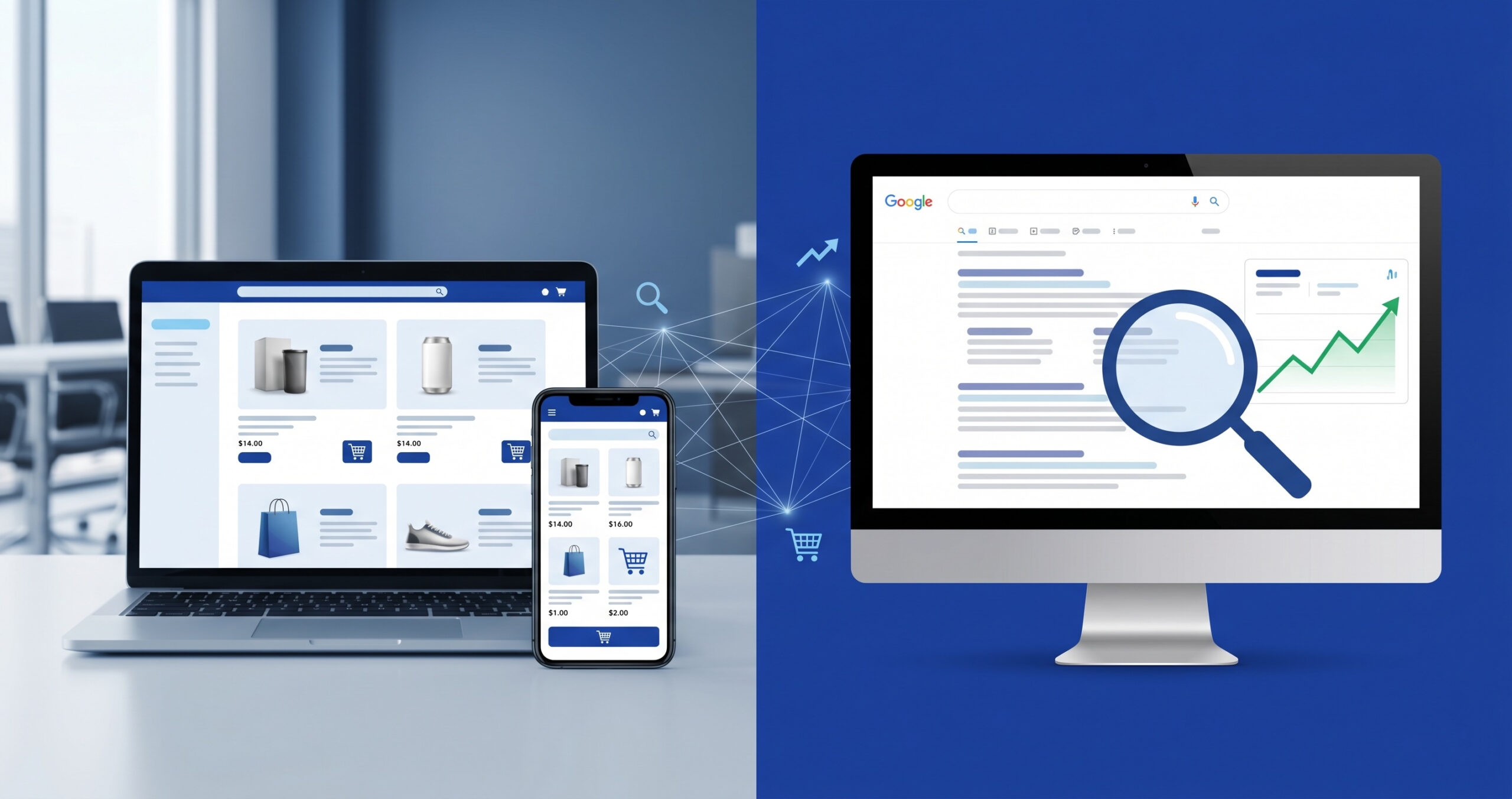
Having an online store is useless if nobody finds it. You can sell the best product at the best price, but if you do not appear in Google when your customer searches, they will buy from a competitor. That is where e-commerce SEO comes in: the work that gets your store found, brings in qualified traffic and turns it into sales.
In this guide you will see, step by step, how to properly rank an online store: from keyword research to technical SEO, product pages and local SEO. All with a practical, business-focused approach rather than one aimed at traffic alone.
We are telling you this from the experience of our digital marketing agency in Barcelona, where we have spent more than two decades ranking projects across Catalonia, including WooCommerce, PrestaShop and Shopify stores.
E-commerce SEO is the set of techniques that get your store into Google’s results when someone searches for what you sell. Unlike SEO for a services site, here you work on four types of page with different goals: the home page (brand), categories (broad traffic), product pages (purchase intent) and the blog (discovery).
The big advantage over advertising: SEO does not stop working when you stop paying. Done well, it attracts qualified traffic consistently and lowers your acquisition cost over the long term. It complements Google Ads rather than replacing it.
It all starts with knowing how your customer searches. Two intents coexist in an online store and they are handled on different pages:
With tools such as Google Keyword Planner, Ahrefs or Semrush you prioritise keywords with real volume and manageable difficulty. The classic mistake is chasing generic terms with no demand or far too much competition: long-tail terms with clear purchase intent are better.
Good architecture is the difference between a store that scales and one that drowns in its own catalogue. The logical hierarchy is always the same:
Home → Category → Subcategory → Product. No strategic URL should be more than 3 clicks from the home page.
That lets Google crawl and index what matters, spreads authority to the pages that sell and helps the user reach the product without detours. Categories need their own optimised text (not just a list), and URLs must be clean and semantic, without runaway parameters.
Product pages are where the sale is decided, and most stores neglect them. To make them rank and convert:
A product page that explains benefits, answers questions and shows the product in use tells Google your page is more relevant than your competitor’s.
In stores with thousands of URLs, technical SEO is the nervous system of your rankings. A structural fault cancels out any content strategy. The critical points:
Not everything should be indexed: keep the basket, checkout and filters with no demand out of the index. Fewer junk URLs = more focus and more authority.
If you are not using Google’s free listings (Merchant Center), you are handing qualified traffic to competitors. They let you appear in the Shopping tab organically, straight to your products.
To do it you need a clean product feed uploaded to Merchant Center, free listings enabled and each product optimised with its keywords. Combine that with structured data (Schema): mark up Product, Offer, Review and Breadcrumb in JSON-LD to earn rich snippets (price, stock, ratings) that lift your CTR and help the AI understand your catalogue.
If your store has physical premises, local delivery or collection, you have an advantage almost nobody uses: combining product SEO with local SEO. You target searches such as “buy [product] in Barcelona” or “[product] fast delivery Catalonia”.
and a consistent NAP across directories.
E-commerce SEO and AI: appearing in ChatGPT and AI Overviews Search no longer happens only in Google: more and more people ask ChatGPT, Gemini or Perplexity for product recommendations directly. And yes,.
AI already recommends products and stores ProductThe good news is that the work overlaps with classic SEO: clear product pages, structured data , a good reputation and a clean feed also help you get cited by the AI. To go deeper, we explain it in our guide onhow to appear in ChatGPT
Mistakes that sink an online store’s SEO
: leaving out two enormous sources of qualified traffic. The good news: fixing them usually produces fast results, because you are not creating anything new, you are simply.
How to measure results and how long they take E-commerce SEO is not immediate, but it is not endless either. Significant movement usually shows between3 and 6 months
, sooner in uncompetitive niches and a little later in saturated sectors. To avoid working blind, measure with four tools: Search Console (impressions, clicks, positions by product), GA4 (organic traffic and events such as add_to_cart or purchase), Merchant Center (free listings) and a rank tracking tool (Semrush, Ahrefs or SE Ranking). What matters is not sessions but.
A final checklist, and why trust JRC Web with your store
Local SEO if you sell in your area, and prepare your store for AI. What does it cost? It depends on the size of the catalogue, the CMS and the competition. A phased strategy with clear objectives makes sense. You can look at our SEO pricing
to get an idea of the investment.
How much does it cost to rank an online store?
How long does e-commerce SEO take to produce results?
WooCommerce, Shopify or PrestaShop for SEO?
Do product pages need their own copy?
Is SEO worth it if I already run Google Ads?
How do you rank an online store in Google?
Ranking an online store rests on four pillars: transactional keyword research, clear architecture (home, categories and product pages), technical SEO (speed, indexing and structured data) and authority through links and reviews. Product pages must have their own optimised content.
How useful did you find this content?
Click a star to rate it!
Average rating!0/ 5. Vote count0
No votes yet! Be the first to rate this post.

How much Google Ads costs: what you pay Google, what an agency charges to manage it and what budget you need for it to pay off.

Web design for freelancers in Barcelona: which pages you need, what it costs and how to get a professional, affordable website that wins clients.

What AI search optimisation (GEO) is and how to get ChatGPT, Gemini and Perplexity to recommend your company in Barcelona.