Digital advertising
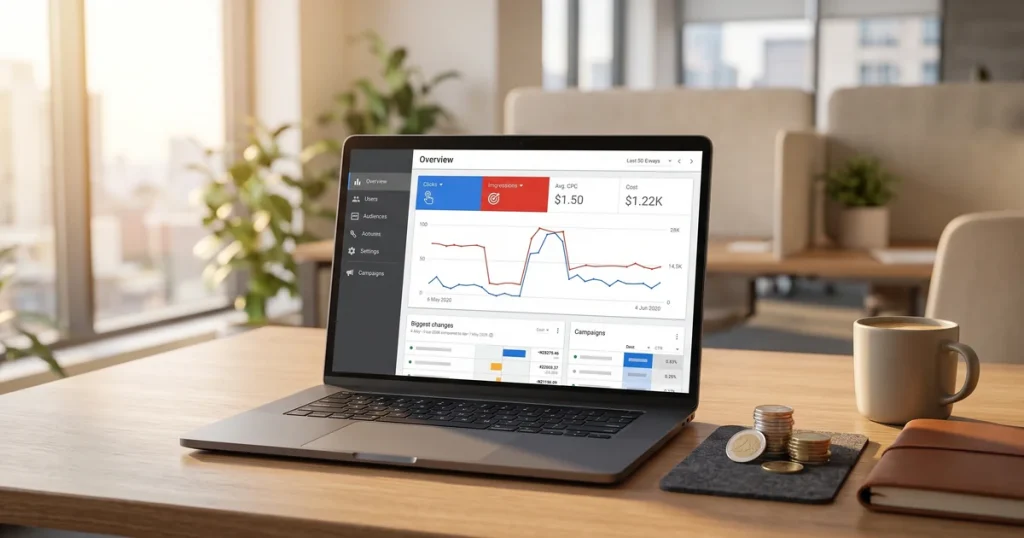
How much Google Ads costs: spend, management fees and a realistic budget
How much Google Ads costs: what you pay Google, what an agency charges to manage it and what budget you need for it to pay off.


93% of online experiences begin with a search engine. Yet most small businesses in Spain have no SEO strategy at all for attracting customers from Google.
Having an SEO strategy is no longer just about appearing in the organic results. Google’s AI Overviews are changing how people find businesses, and small companies with well-structured content and a solid online presence have the advantage.
In this guide we explain what SEO means for a small business, which strategies work, what it costs and how to get started. From our search marketing agency, where we have spent two decades helping small businesses win customers from Google.
SEO for small businesses is the set of techniques that get your site into Google’s top results when a potential customer searches for the products or services you offer. It is not magic or trickery: it is steady work on technical optimisation, relevant content and building online authority.
Unlike paid advertising, where you disappear the moment you stop paying, SEO produces results that last. Once your site holds good positions, organic traffic becomes a steady source of visits and potential customers.
SEO for small businesses has its own characteristics. Budgets are usually tighter, the team is small and the competition may include far bigger companies. But it also has advantages: more agility to implement changes, the ability to focus on specific niches and the power of local SEO to win nearby customers.
When someone needs a service or product, the first thing they do is search Google. If your company does not appear in those results, as far as that potential customer is concerned you simply do not exist. It is that simple and that brutal.
Permanent visibility: your site works for you 24 hours a day, 365 days a year. There are no opening hours and no geographic limits. As long as your site ranks well, it attracts visits constantly.
Credibility and trust: people trust organic results more than ads. Appearing at the top of Google conveys professionalism and authority in your field.
Long-term profitability: unlike online advertising, organic traffic has no cost per click. The initial SEO investment pays for itself over time and the return is usually far higher than other marketing channels.
Competitiveness: if your competitors already do SEO and you do not, you lose market share every day. Investing in rankings lets you compete on equal terms, even against bigger companies.
One of the first questions any small business asks is what SEO will cost. The answer depends on several factors, but here are real price ranges in the Spanish market:
A freelance SEO consultant: between €300 and €800 a month. The cheapest option, ideal for small businesses that want a personal approach without a big investment. The drawback is depending on one person whose availability may be limited.
An SEO agency: between €500 and €2,000 a month. They offer multidisciplinary teams with specialists in content, technical work, link building and analytics. The most complete option, though also the biggest investment.
SEO by project: between €1,000 and €5,000 (a one-off payment). It covers a technical audit, initial optimisation and an action plan. Ideal for businesses that want a solid base and then handle maintenance in house.
What matters is not finding the cheapest but understanding what each service includes. SEO at €50 a month is unlikely to move the needle for your business. Be wary of offers promising first place in Google for derisory prices.

Not all SEO strategies are equal, nor do they all need the same resources. These are the ones that work best for small businesses on a limited budget:
Focused keyword research: keyword research is the foundation of everything. Small businesses should prioritise long-tail keywords (more specific, less competitive). Instead of trying to rank for “lawyers”, aim for “employment lawyer central Barcelona”. Fewer searches, but far more purchase intent.
Quality content: create content that answers your customers’ real questions. A blog with useful, well-optimised articles can generate steady traffic for months or years. The key is writing for people, not just for search engines.
Basic technical optimisation: make sure your site loads fast, is responsive on mobile, has clean URLs and contains no errors. These technical factors are fundamental and many small businesses neglect them entirely.
Smart link building: earning quality links to your site improves your authority in Google’s eyes. For small businesses, the best sources are local directories, collaborations with suppliers and industry associations.
If your business serves customers in a particular area, local SEO is your best ally. While big companies compete nationally, you can dominate the search results in your city or neighbourhood.
The first step is creating and optimising your Google Business Profile . Fill in everything: name, address, phone, opening hours, quality photos and the right categories. That profile is what puts your business on Google’s map when someone searches for services nearby.
Reviews are gold for small businesses. People trust other customers’ opinions enormously. Actively ask happy customers to leave a review and always reply, to positive and negative ones alike. Managing reviews well improves your position in Google’s local pack.
Do not forget to include your town in your website copy, page titles and meta descriptions. If you are an electrician in Terrassa, make sure Google knows it. The clearer your location signal, the more likely you are to appear when someone searches nearby.
It is a frequent question, and the answer is that they are not mutually exclusive but complementary. If budget forces you to choose, though, it helps to understand the differences.
Google Ads gives you immediate results. You pay per click and appear at the top instantly. When you stop paying, you disappear. It is ideal for one-off campaigns, launches or when you urgently need customers. The problem for many small businesses is that cost per click can be high in competitive sectors.
SEO is a medium to long-term investment. Results take longer (between 3 and 12 months), but once you rank, organic traffic is free and sustainable. People also tend to trust organic results more than ads.
The smartest strategy for a small business is usually to combine both: use Google Ads to generate revenue in the short term while SEO builds authority. As organic traffic grows, you can cut back on paid advertising.
Many small businesses make SEO mistakes through inexperience that cost them positions and customers. These are the most frequent:
Not having a mobile-optimised site: more than 60% of searches happen on a phone. If your site does not look right on a small screen, Google penalises you and visitors leave.
Ignoring loading speed: every extra second of loading raises your bounce rate. Uncompressed images, cheap hosting and unnecessary plugins are the usual culprits.
Creating content with no keyword strategy: publishing articles at random without researching what your audience looks for is a waste of time. Every page should target a specific keyword with clear search intent.
Forgetting local SEO: many small businesses with premises do not even have a Google Business Profile. That is handing visibility to the competition.
Expecting immediate results: SEO does not work like advertising. It takes persistence and patience. Giving up after two months because nothing has happened yet is one of the most expensive mistakes.
You do not need to spend thousands on professional tools to start with SEO. These free options cover the essentials:
Google Search Console: essential. It shows which keywords your site appears for in Google, how many clicks you get, indexing errors and technical problems. If you only use one tool, make it this one.
Google Analytics: lets you see how many visits your site gets, where they come from, which pages they view and how long they stay. Fundamental for measuring the impact of your SEO work.
Google Business Profile: completely free and essential for local SEO. It lets you manage how your business appears on Google Maps and in local searches.
PageSpeed Insights: analyses your site’s speed and gives concrete recommendations for improving it. Speed is a ranking factor you can optimise at no cost.
Ubersuggest (free version): lets you do basic keyword research, see search volumes and analyse the competition. Limited, but enough to get going.
SEO does not deliver overnight. These are realistic timescales for a small business:
Months 1-3: the audit, technical optimisation and initial content creation phase. You probably will not see significant traffic changes yet, but Google starts crawling and indexing the changes.
Months 3-6: the first movement in positions becomes noticeable. Some long-tail keywords start ranking and organic traffic begins to grow. This is the stage where many small businesses give up out of impatience, just as it starts working.
Months 6-12: results accelerate. Positions consolidate, traffic grows steadily and real leads and customers start arriving from Google.
To measure whether your investment is working, track these indicators in Google Analytics and Search Console: organic traffic (visits from Google), keyword positions (where you appear), organic conversions (forms, calls and sales generated by SEO traffic) and cost per acquisition (your SEO spend divided by new customers). Compare that last figure with what a customer costs you through Google Ads: in most cases, SEO wins comfortably over the medium term.
Each option has pros and cons. The best one depends on your budget, the time you have and your technical knowledge:
Doing it yourself: viable if you have the time and the appetite to learn. With the free tools mentioned above and some basic training, you can cover the essentials: optimising your Google Business Profile, creating blog content and making basic technical improvements. The risk is making mistakes through inexperience, or spending time you could be investing in your business.
A freelance SEO consultant: a good option for small businesses with a moderate budget (€300-800/month). You get personal attention and a professional dedicated to your project. It works well when you need a clear strategy and someone to guide you.
An SEO agency: the most complete option. You get a team of specialists across different SEO areas (technical, content, link building, analytics). Ideal when you want ambitious results and can invest €500 or more a month. The advantage is not depending on one person, and results tend to be more consistent.
Whatever you choose, make sure the professional or agency offers transparency: monthly reports, clear objectives and open communication. Run from anyone promising first place in Google within a month.
If you have read this far, you know how important SEO is for growing your business. The question now is taking action.
At JRC WEB we specialise in SEO strategies designed for small businesses that want to compete in Google without wasting budget. Our approach is practical: we analyse your business, identify the real opportunities and build a tailored strategy with clear objectives and realistic timescales.
We know every euro counts when you are a small business, so we focus on the work with the biggest impact: technical SEO, optimised content, local SEO and a link strategy that builds your site’s authority naturally.
It depends on the professional and the type of service. A freelance consultant charges between €300 and €800 a month, while an SEO agency can cost €500 to €2,000 monthly. There are also one-off audit and initial optimisation projects from €1,000. What matters is assessing what each quote includes rather than being drawn in by offers that are too cheap.
The first movement is usually noticeable between months three and six, and the more solid results arrive from 6-12 months. Factors such as the competition in your sector, your site’s current state and the investment made all affect the timescales directly. SEO is a medium to long-term strategy.
Yes, you can start with the basics: optimising your Google Business Profile, creating useful blog content, improving your site’s speed and setting up Google Search Console. For more advanced work such as technical audits or link building, a professional is worth having to avoid expensive mistakes.
They are not mutually exclusive. Google Ads generates immediate results but needs constant investment. SEO takes longer to bear fruit, but organic traffic is free and sustainable. The best strategy is usually to combine both: advertising for the short term while SEO builds lasting results.
The results do not disappear immediately, but they degrade steadily. Competitors keep working and Google keeps updating its algorithm. If you stop creating content and earning links, your positions will slip bit by bit. SEO needs continuous maintenance to hold and improve results.
Yes. Google’s AI Overviews do not discriminate by company size but by content quality and domain authority. A small business with a well-structured site, useful content, clear FAQs and correct schema markup can appear in AI-generated answers, especially for local and niche searches.
SEO for small businesses is not a luxury reserved for large corporations: it is a strategic investment within reach of any company that wants to grow. With the right strategy, accessible tools and a little patience, your business can compete in Google and attract customers steadily. What matters is starting, measuring results and adjusting as you go. Your website can be your best salesperson if you give it the tools to be one.
How useful did you find this content?
Click a star to rate it!
Average rating!0/ 5. Vote count0
No votes yet! Be the first to rate this post.
How much Google Ads costs: what you pay Google, what an agency charges to manage it and what budget you need for it to pay off.
Web design for freelancers in Barcelona: which pages you need, what it costs and how to get a professional, affordable website that wins clients.

What AI search optimisation (GEO) is and how to get ChatGPT, Gemini and Perplexity to recommend your company in Barcelona.