Digital advertising
How much Google Ads costs: spend, management fees and a realistic budget
How much Google Ads costs: what you pay Google, what an agency charges to manage it and what budget you need for it to pay off.

Do you really know what web design is and why it matters for your online presence? Having a good-looking website is not enough: you need one that loads fast, shows up on Google and turns visits into clients. At ourweb design agency we have spent over 20 years building professional websites that deliver real results.
In this guide we explain what web design is, its main elements, the differences between custom design and templates, and how to choose the best option for your business.
Última revisión: mayo 2026
Web design is far more than picking pretty colours and dropping a logo into the corner of a page. It is about creating effective digital experiences, attractive and functional, for the people who visit a website. When we talk about web design, we mean the planning, conceptualisation and organisation of online content, combining visual, technical and interaction elements to achieve one clear goal: connecting with people.
These days, having a professional website is not optional. It is your calling card, your sales channel, your 24/7 office. And if it does not convey trust, clarity and value within the first few seconds, you lose opportunities. That is why understanding what web design really is, and how to apply it properly, can make the difference between having a simple “page” and having a genuine business tool.
From our experience as a web design agency, we have seen that design does not only communicate who you are: it also guides the user, improves conversion and raises the perceived professionalism of your brand. What is more, we offer tailor-made solutions for every kind of client, because we know that each business needs a website that represents it and works as a natural extension of its identity.
When we talk about modern web design, we are not simply talking about following trends. We are talking about putting in place the essential components that make sure your site is not only visually attractive, but also usable, fast and suited to any device. Here are the key elements no site can do without:
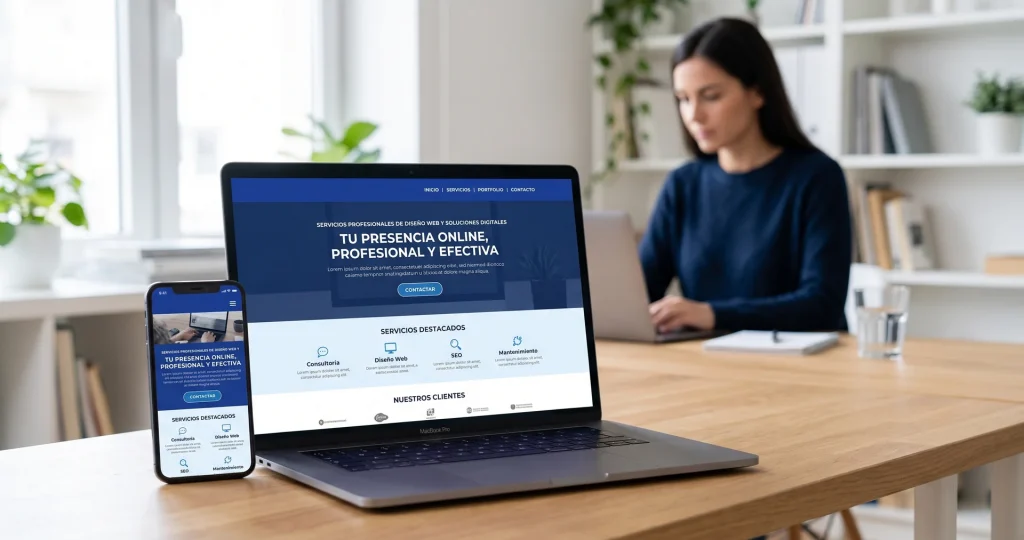
Your site has to look good on desktops, mobiles and tablets. A responsive design ensures that your website adapts automatically to the screen size, improving the user experience and meeting Google’s requirements.
The right use of sizes, colours and typography guides the user’s attention. A well-considered visual hierarchy helps the most important things stand out and makes everything easier to read.
A well-organised menu is essential. Nobody wants to “get lost” on a website. Navigation should be simple, intuitive and reachable from any page.
A beautiful design that takes 5 seconds to load… is a failure. Image optimisation, clean code and lightweight resources are essential to keep users on your site.
Modern web design has to be inclusive, allowing people with different abilities to browse without difficulty. That covers everything from colour contrast to the labels on your buttons.
We apply these elements systematically to every project we build, adapting them to the client’s visual identity and commercial goals. The result: websites that do not only look good, but work and sell.
One of the most common dilemmas for entrepreneurs and companies is whether to go for a custom web design or a pre-built template. Both options have advantages, but the choice depends on what you are looking for and your resources.
At our agency we favour custom solutions, because we believe every client has unique needs. We often get businesses that started with a template such as WordPress and got stuck. In those cases we redesign from scratch, and the jump in quality and results is immediate.
Web design is not just about aesthetics. It is also about how it feels to browse a website. Two key concepts come into play here:
UX (User Experience): this is about how the user interacts with your site. Is it easy to find what they are looking for? Is the navigation intuitive? Is the speed up to scratch?
UI (User Interface): this is the visual side: colours, buttons, typography, animations. Everything the user sees and interacts with.
In our projects, we apply user-centred design principles. One of our clients, for example, had an extremely high bounce rate. By analysing their user experience, we redesigned menus, simplified forms and reorganised content. The result: +40% more time on site and +25% more conversions.
Having a website that only works on desktop computers is no longer an option. According to Google, more than 60% of web traffic is mobile. If your page does not adapt to these devices, you are losing visitors, leads and sales.
Responsive web design means that every element adjusts dynamically to the screen size. That includes menus, images, columns and buttons. As well as improving the user experience, Google gives a ranking boost to websites that are fully responsive.
At our agency we always work to a mobile-first approach: we design for mobile first and then adapt to desktop. This lets us prioritise what matters and leave out anything unnecessary.
Investing in professional web design is not an expense, it is an investment that delivers a return. Here is why:
Better search rankings
A site that is well structured, fast and optimised performs better in Google. It also adapts to algorithm changes.
More conversions
Good design guides the user towards specific actions: buying, signing up, getting in touch. That translates into tangible results.
Builds trust and authority
A clean, clear and professional website projects credibility. Design says as much as the words do.
Scalability and easy management
Professional development makes future integrations straightforward: ecommerce, CRM, campaigns, advanced analytics…
As an agency, we see it day after day: businesses that have their website professionally updated increase their revenue and improve their digital reputation.
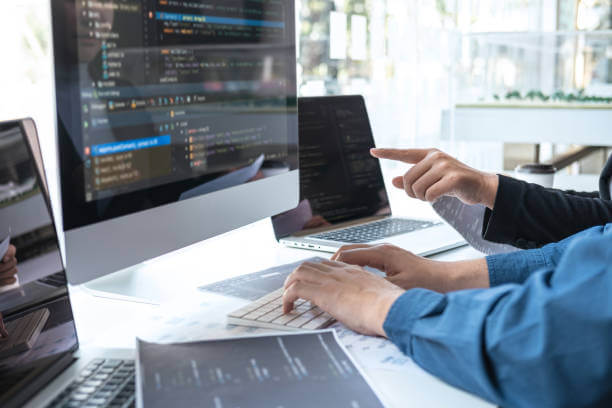
We do not believe in off-the-shelf solutions. At our web design agency we offer tailor-made solutions for every kind of client. From a local restaurant to an international technology firm, we adapt each site to its needs, its goals and its target audience.
We like to be involved at every stage of the process, from strategy through to technical implementation. We build websites that connect visually, perform technically and are ready to grow.
The trust our clients place in us comes from the personal approach we take: we listen, we propose, we design, we build and we stay alongside you. Every project is unique, and we love proving that good web design makes all the difference.
Plenty of sites fail because they fall into mistakes that are easily avoided. Here are the most common ones:
Confusing or hidden menus.
Too much text or heavy images.
No clear visual hierarchy.
Formularios interminables.
Non-responsive websites.
Avoiding these mistakes does not only improve the user experience, it also has a direct impact on business results. When we design, we assess every element through the lens of “does this make the user’s action easier or harder?”.
The world of web design never stops evolving. Here are some of the trends shaping 2025:
Minimalist designs and large typography
Smooth animations and microinteractions
Modos oscuros
Ultra-optimised speed (Core Web Vitals)
AI integration and custom chatbots
We are already building these trends into our projects, but always with one principle in mind: they must serve the user and the business goal, not just “look pretty”.
Web design is the process of creating the visual and functional structure of a website. It spans everything from aesthetics (colours, typefaces, images) to technical aspects such as usability, accessibility and user experience.
Web design focuses on the visual side and the user experience (UX/UI), while web development takes care of coding the site and making it work. Both are essential and go hand in hand.
Because more than 60% of web traffic comes from mobile devices. A responsive site adapts to any screen, improves the user experience and is fundamental to SEO.
Timescales vary with the scope. A basic site can be ready in 2-3 weeks. A full bespoke design can take from 4 to 8 weeks or more.
Click to rate this post!
How useful did you find this content?
Click a star to rate it!
Average rating!0/ 5. Vote count0
No votes yet! Be the first to rate this post.
How much Google Ads costs: what you pay Google, what an agency charges to manage it and what budget you need for it to pay off.
Web design for freelancers in Barcelona: which pages you need, what it costs and how to get a professional, affordable website that wins clients.
What AI search optimisation (GEO) is and how to get ChatGPT, Gemini and Perplexity to recommend your company in Barcelona.